

Branded Search Is a Ranking Signal: Decoding Google’s “Site Quality Score” Patent (US9031929)

Branded Search Is a Ranking Signal: Decoding Google’s “Site Quality Score” Patent (US9031929)
How a Google patent ties branded search volume to a site-wide quality score.
 Ian Sorin
June 26, 2026
14 min read
Ian Sorin
June 26, 2026
14 min read
- In 2012 Google patented a “Site Quality Score” (US9031929) co-invented by Navneet Panda, the engineer Google’s Panda system is named after.
- The core idea is a ratio: how many distinct branded / navigational queries point at your site, over your total search demand. People searching for you by name is the signal.
- The formula is (S − T) / Un, where S is your branded queries, T a noise threshold, U your total queries and n a dampener.
- It is a 2012 patent, so treat it as a lens, not Google’s live code. But 2024 data from Moz lines up with it: update losers had weak brand demand relative to their links.
- Actionable: audit your branded-demand ratio (calculator below), then deliberately grow branded searches.
Picture two competing websites in the same niche. Similar content, roughly the same number of backlinks pointing at them. A core update rolls out.
One barely moves. The other loses half its traffic overnight.
If you have spent any time watching Google updates, you have seen this exact scene. And the usual explanations (content quality, E-E-A-T, freshness) sometimes aren’t enough to explain why one survived and the other did not.
Sometimes the place to look isn’t your on-site SEO at all. It is on the branding side, and one thing in particular: how many people search for you on purpose. Google even patented a version of that idea back in 2012, and it has nothing to do with how well your content reads.
What this patent actually is
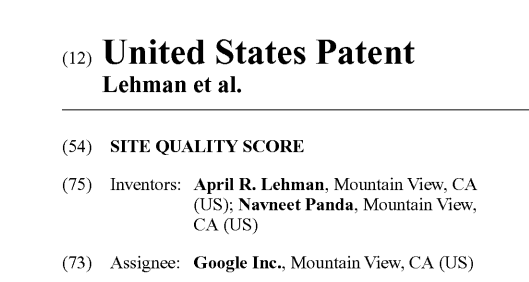
The patent is US9031929B1, titled “Site Quality Score”. Google filed it on June 27, 2012 (with a priority date of January 5, 2012) and it was granted on May 12, 2015.
Two details make it worth your time.
First, one of its two inventors is Navneet Panda, the Google engineer the “Panda” quality system is literally named after. So we are reading something close to the DNA of Google’s first big push on site quality.
Second, the whole thing reduces to one almost blunt idea: a site is higher quality when a large share of the interest it gets comes from people looking for that site specifically, by name.
A quick, honest caveat before we go further. This is a 2012 patent. Google’s systems have moved on a lot since, with NavBoost, the Helpful Content system and plenty more.
I am not claiming Google runs this exact formula today. I am saying the idea inside it is very much alive, and later I will show you 2024 data that lines up with it almost perfectly.
The big idea: branded demand vs total demand
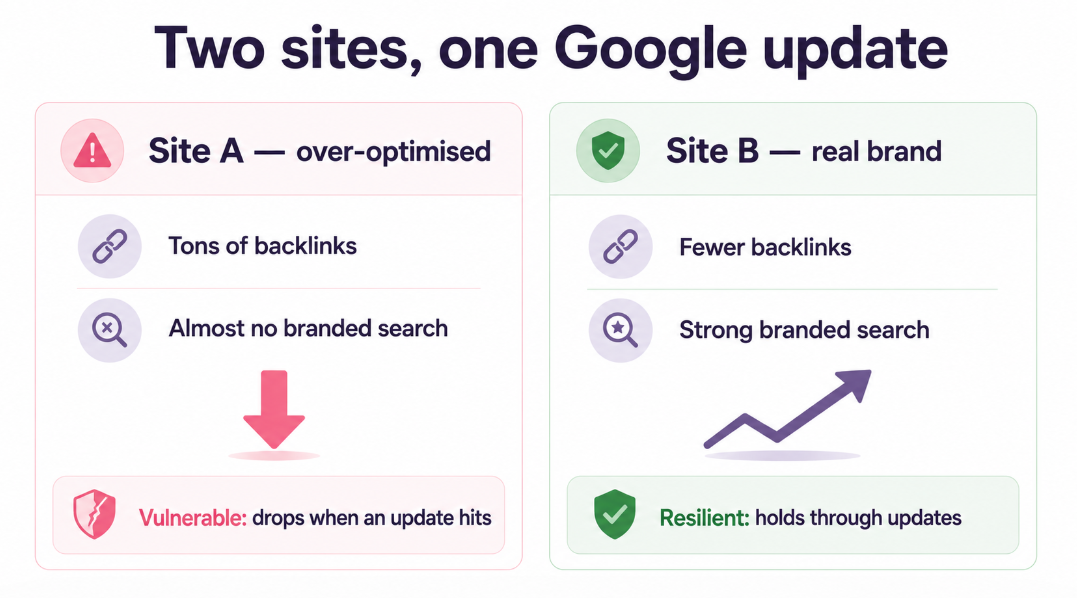
Forget the math for a second. Here is the intuition.
Every site attracts two kinds of search interest.
One kind is people searching for the site itself: “decathlon”, or “decathlon cap”. They already know the brand and want it.
The other kind is people searching for a generic need, like “best running cap”, who simply happen to land on a site from the results.
The patent’s bet is that the first kind is a far stronger quality signal than the second. If many people seek you out by name, you have earned real demand. If you only ever show up because you ranked for generic terms, that interest is borrowed, not owned.
So the score rewards the ratio between “people who want you” and “all the interest you capture”. A site that is constantly searched for by name scores high. A site with plenty of traffic but almost no one searching its name scores low.
The formula, decoded
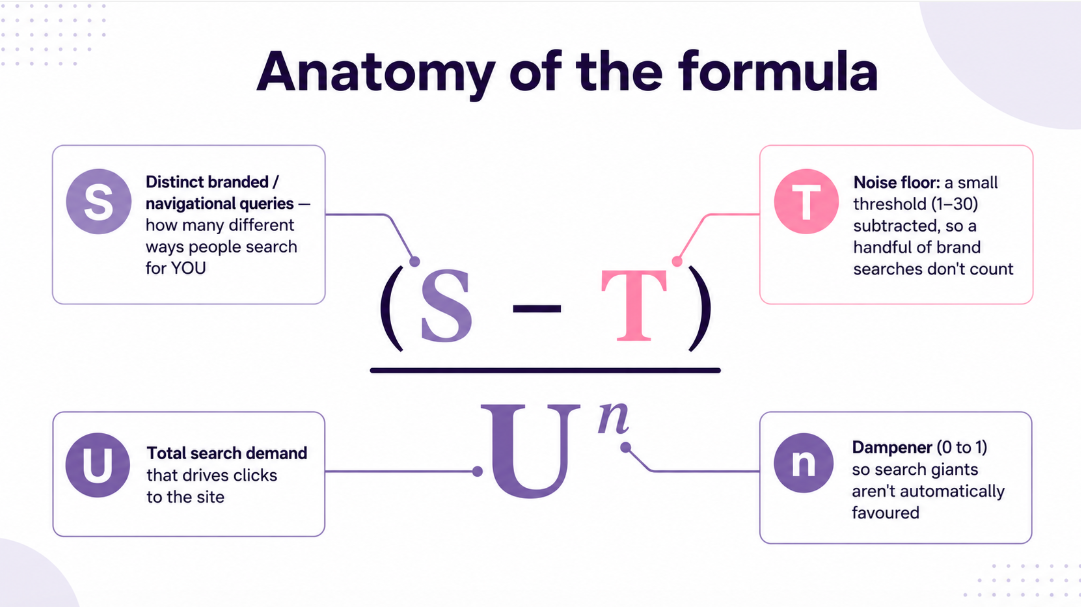
The patent expresses the score as a ratio. In its simplest form it is just S / U, then refined. The version most people quote is:
(S − T) / Un
Let me translate each part into plain English, because every letter matters.
S is the count of distinct queries categorised as referring to your site (your branded and navigational queries). The patent counts unique queries, so what matters is how many different ways people search for you, not how many times they repeat the same one.
T is a threshold subtracted from S, “a number from 1 to 30” in the patent’s own words. It is a noise floor: it stops a site with two or three brand searches from getting credit. You need a real minimum of branded demand to count.
U is the count of unique queries associated with your site through user clicks. In practice, your total search demand.
n is an exponent “between 0.0 and 1.0” applied to U. The patent’s own word for what it does is dampen: it softens how hard the denominator pushes the score down. At n = 1 you divide by your full total demand, so the score is a clean proportion, the share of your demand that is branded. The lower n drops, the less your sheer volume of total searches drags the score down, so a site is not punished too harshly just for being large. It is the knob that sets how much raw size should count.
Estimate your own brand-demand signal
I built a small calculator on the same logic. It does not pretend to be Google’s exact production score (nobody outside Google has that). It gives you the readable version: what share of your search demand is genuinely branded.
Illustrative bands: under 5% weak, 5–25% solid, over 25% strong. This is a readable proxy, not Google’s internal score.
Where to find your S and U in Search Console
You can get a rough version of both from the Performance report in Google Search Console.
U (total demand): your total number of distinct queries over the period (the Queries tab).
S (branded demand): filter queries that contain your brand name (and the obvious misspellings), then count those. That filtered slice is your branded demand.
It is an approximation, not Google’s internal number. But the ratio between the two is exactly the kind of thing the patent looks at, and it makes for a genuinely useful health check.
And benchmark it against your competitors. The absolute number barely matters on its own: remember the patent treats this as a relative signal, comparing sites to one another.
So run the same two numbers for two or three competitors and see where you land. If you are struggling to rank, or an update knocked you down, that gap is often where the real story is.
It also works as a preventive check: knowing how your branded demand stacks up against your rivals tells you how exposed, or how protected, you are before the next update hits.
The variants Google actually patented
One thing worth being precise about: the patent does not commit to a single formula. It lists several, each introduced with the same “can also be determined” phrasing, which in patent language means they are co-equal options, not a ranked list. Google was casting a wide net to protect the idea, not publishing its live recipe.
Rather than memorise these, read them as Google stacking one safeguard at a time. The heart never changes (branded demand over total demand); each version just patches an edge case the previous one left open:
- S / U : the raw idea. What share of your demand is people asking for you by name? Clean, but easily skewed when the numbers are small.
- (S − T) / U : subtract a small threshold T (the patent says somewhere from 1 to 30) so a site with two or three brand searches earns nothing. It strips out noise.
- max(L, S − T) / U : wrap the top in a floor L (usually 0) so that subtraction can never push the numerator below zero. A safety net, no more.
- S / Un : dampen the bottom. Raising U to a power under 1 (the patent floats 0.5 to 0.9) keeps a massive total volume from crushing the score. This is the dial we just walked through.
- S / (B + Un) : add a base value B to the bottom (the patent mentions anywhere from 1 to 100) so tiny sites with barely any data don’t swing to wild, unstable scores.
- max(L, S − T) / (B + Un) : every safeguard at once. Intimidating on paper, but underneath it is still branded demand divided by total demand.
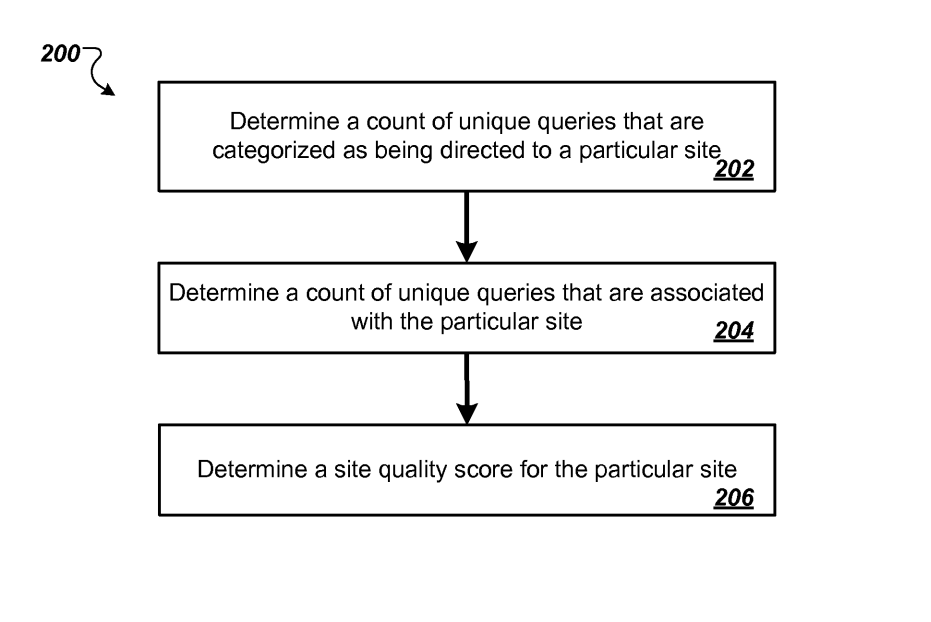
And there is a second flavour entirely. Figure 2 counts unique queries. Figure 3 runs the same logic but counts user selections (clicks): how many clicks came from branded-query results, over total clicks to the site.
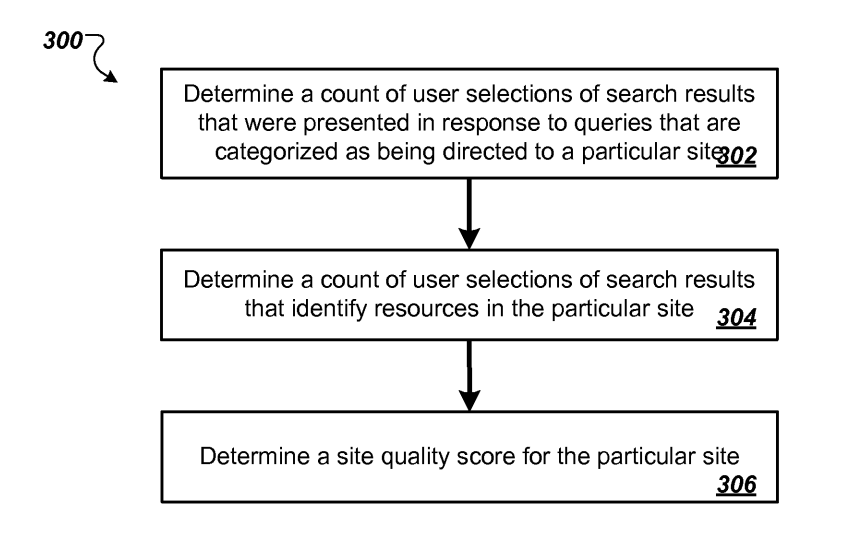
The plumbing changes; the idea never does. Every variant measures the same thing: branded, intentional demand relative to total interest.
How Google decides a query points to your site
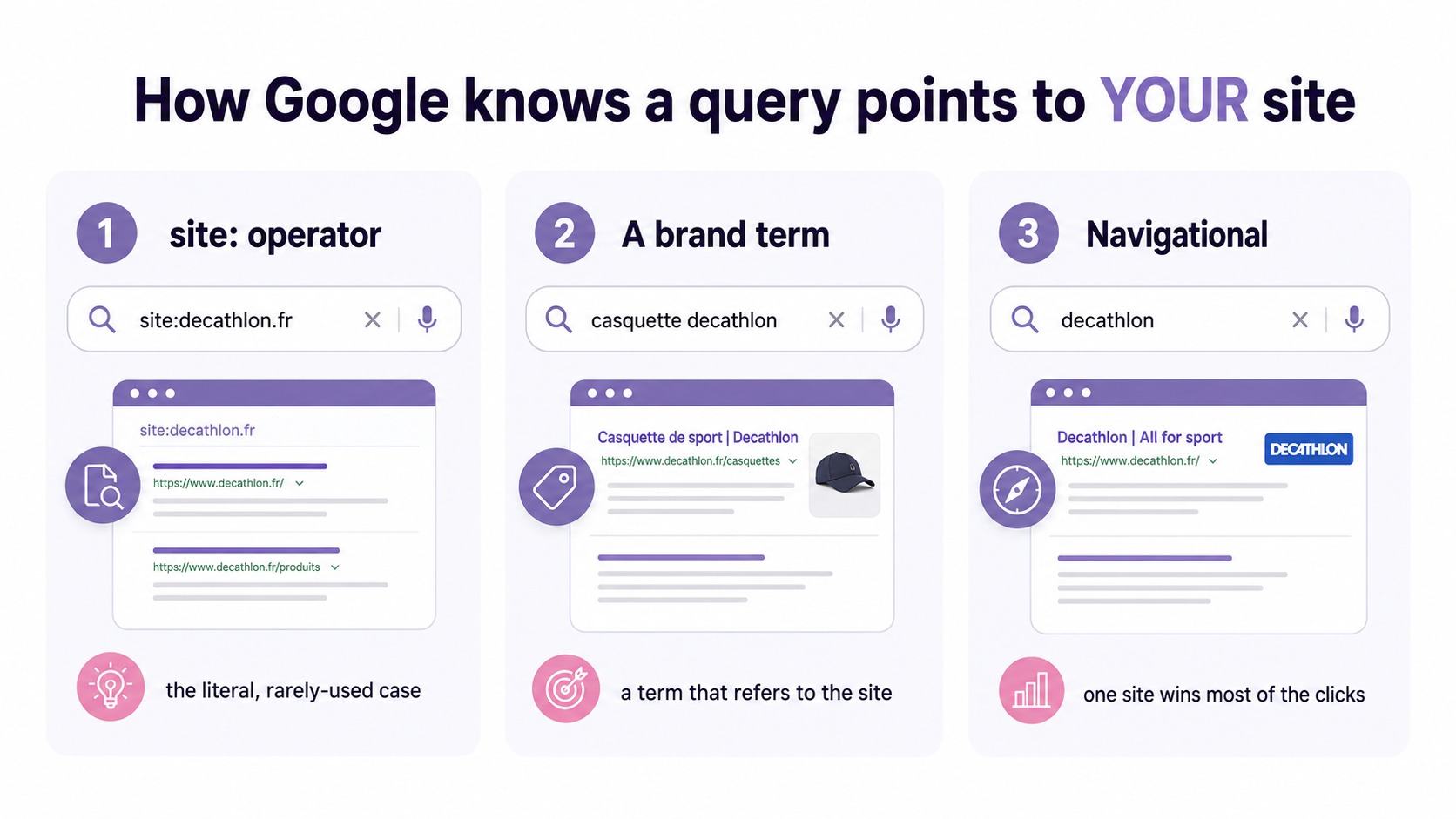
For any of this to work, Google has to decide which queries “refer to” your site. The patent spells out three ways. Using Decathlon as the running example:
1. The site: operator. A query like site:decathlon.fr explicitly names the site. This is the literal case, and honestly almost nobody searches this way, so set it aside for practical purposes.
2. A term that refers to the site. The patent gives its own example: if Google has data that “esf” is commonly used to mean “sf.example.com”, then queries containing “esf” count as referring to that site. In our case, “casquette decathlon” contains a brand term that points straight at Decathlon.
3. A navigational query. If one result captures at least a threshold share of the clicks for a query, Google treats that query as navigational to that site. Type “decathlon” and one site wins almost all the clicks: that is navigational.
The second and third are the ones that matter for you. They are exactly the searches a real brand earns: people typing your name, or your name plus a product.
From 2012 to today: does this still hold?
Here is where it gets interesting, because we have recent, independent data.
In May 2024, a large set of Google’s internal Search documentation leaked, and Mike King of iPullRank published an early breakdown. Among thousands of attributes, the docs literally contain a signal named “babyPandaDemotion” (and a “babyPandaV2Demotion” described as “applied on top of Panda”).
I want to be careful here. The leak confirms these names exist in Google’s documentation, nothing more. The idea that “babyPanda” is the Helpful Content Update is Mike King’s hypothesis, not a documented fact, and Google has only confirmed that the documents are authentic, not how any of it is weighted. Treat it as a strong lead, not a conclusion.
What turned a hypothesis into something more concrete is Moz’s data. Tom Capper, who leads search science at Moz, studied sites that lost and won across the September 2023 and March 2024 Helpful Content and core updates.
His finding, in his own words: “HCU was about the demand for your brand.” The losers had markedly lower Brand Authority and a much higher Domain-Authority-to-Brand-Authority ratio than the winners.

In numbers: update losers averaged a Brand Authority of 37, against 50 to 52 for winners and unaffected sites, and a DA:BA ratio of about 2.0 versus roughly 1.4.
Quick definitions, because these are Moz metrics, not Google’s:
Domain Authority (DA) is Moz’s 1-to-100 score built mainly from your backlink profile. Think of it as link strength.
Brand Authority (BA), launched by Moz in August 2023, is a 1-to-100 score built mainly from branded search volume. Think of it as how much people search for you.
So a high DA:BA ratio means “lots of links, not much brand demand”. That is precisely the imbalance the 2012 patent was built to catch. Twelve years apart, the same idea: links without branded demand are a weak foundation.
Capper is honest that BA is not a Google ranking factor (it is a Moz metric, and Google does not buy Moz’s data), so this is correlation, not proof. He even points to another Google patent in the same family, US8682892B1 “Ranking search results” (also co-invented by Navneet Panda), which adjusts rankings using a ratio of independent links to “reference queries”: conceptually, a links-to-brand ratio.
It also rhymes with click-based signals like NavBoost, which I have written about before. The common thread across all of it is user behaviour: who actually seeks you out. (If you like decoding Google patents, I did the same with keyword prominence.)
My own read: the analysis Google runs today is surely far more evolved than a single 2012 ratio. But this patent is still a healthy base to reason from and to audit your own situation. And it matches something you feel every day in the SERPs: a popular brand, with real branded searches, carries weight.
What this means for you (and how to grow branded search)
If branded demand is this load-bearing, then “building the brand” stops being a fluffy line and becomes part of your SEO job. Not all of it, but a real part.
The good news: you can actively manufacture branded searches. Here are tactics I actually use and recommend.
For a deeper set of these moves, I put together a whole piece on it: the outside-the-box SEO tactics that actually drive business.
The point is simple. A backlink is something you ask for. A branded search is something you earn. Google has been trying to tell winners from losers on exactly that difference since at least 2012.
The takeaway
A 2012 patent, co-written by the engineer behind Panda, says the quiet part out loud: Google has long looked at how many people search for you by name, relative to all the interest you capture, as a sign of quality.
The exact formula has surely evolved. But every signal we can see from the outside, from the 2024 leak to Moz’s update data, points the same way.
You feel it in the SERPs too: strong brands are sticky, and they ride out updates that flatten everyone else.
So audit your own branded demand, then go make more of it. It is one of the few SEO investments that compounds, and that no algorithm tweak can easily take away.
That’s all for today. Bye!
Ian Sorin is an SEO consultant based in Lyon, France. With a deep passion for understanding how search engines work under the hood, he specializes in technical SEO and data-driven strategies.