

Link Buying for SEO: My Complete Process

Link Buying for SEO: My Complete Process
My full, unsponsored process for buying links, criteria, PageRank mechanics confirmed by Google Leaks and DOJ antitrust documents, what works, what doesn't. No affiliates. No fluff.
 Ian Sorin
July 24, 2026
39 min read
Ian Sorin
July 24, 2026
39 min read
- Link buying can still work, but the conditions for success are far more complex than they used to be. Google is significantly better at filtering spam, and a lot of money gets wasted on links just because “you have to build links.” It’s not a silver bullet, not right for every site or strategy, and expensive enough that ROI needs to be solid before you commit.
- There is no single PageRank. Google runs multiple variants (standard, thematic, Nearest Seed). Third-party metrics are rough proxies, not the real thing.
- Google Leaks confirm a tiered index. Links from TYPE_LOW_QUALITY pages (Tier 3) don’t meaningfully count. Most cheap VDL links live here.
- Early quality links protect a domain algorithmically from future Penguin updates, confirmed by a boolean flag in the internal codebase (
penguinEarlyAnchorProtected). - Transition Rank takes ~3 months. Buy links at least 3-4 months before your seasonal peak, or you’re paying for nothing this cycle.
The Link Market: A Special Kind of Madness
Most content about link buying exists because someone profits from the outcome. A platform gets promoted, a commission gets paid, a retainer gets signed. What gets left out is the actual mechanics: how links work inside Google’s systems, what makes a placement worth its price, why most of the criteria people use are wrong, and above all, when link buying actually makes sense versus when it’s just expensive noise.
France has one of the most developed link-selling ecosystems in the world. Dozens of platforms, hundreds of resellers, a constant stream of communication pushing you to “absolutely buy links.” The noise is deafening. And within that noise, a lot of 2010-era thinking gets recycled as if nothing has changed.
Let me be clear about where I stand: link buying can be a useful part of an SEO strategy, but it is not the obligatory move it’s often made out to be. A significant portion of what I see in practice, across client projects and competitor analyses, is simply wasted budget. Links that don’t move rankings. Spend justified by “you need to build links,” not by a clear diagnosis of why a specific page isn’t ranking.
The right question before buying any link is not “which platform?” but “does this page actually need a link right now, and if so, will this specific link help?” Test and measure. For every link you buy, check what happened on the target page three months later. If the ROI isn’t there, don’t force it.
This article is my full take on the topic: criteria, process, things I’ve tested, things that failed, and what the Google Leaks, patents, and DOJ antitrust documents have confirmed or complicated over the past few years. By the end, you’ll be able to look at any link offer and judge three things fast: whether the target page even needs a link, whether the spot is worth its price, and whether the spend will actually pay for itself. No affiliate links, no platform paying me to say it’s good. Which, given the topic, feels like the least I can do. 😉
How Links Actually Work
The basics: links pass authority (often called “juice”). But the mechanics underneath are more interesting, and more useful to know.
The Random Walker Model
PageRank was introduced by Brin and Page in 1998. The core intuition: imagine a random surfer browsing the web. At each page, they either click a random outgoing link (85% of the time) or teleport to a completely random page anywhere on the web (15% of the time). The PageRank of a page = the probability that this random surfer is on that page at any given moment.
That 15% teleportation factor is the damping factor (0.85). It’s what prevents PageRank from pooling at a few nodes and keeps the whole system stable.
One important implication: a page with no outgoing links forces the surfer to always teleport when they leave it. That’s a net loss of popularity for the entire surrounding network. It’s one reason why “PageRank sculpting” through blocking outgoing links never really worked, Google adjusted the model to account for dangling nodes.
In 2012, Google evolved to a "reasonable surfer" model, links are now weighted by their probability of being clicked. An editorial link in a paragraph of text is treated as more likely to be clicked than a footer link or a sidebar widget. Consequence: context and placement matter for the value a link transmits.
There Is No Single PageRank
This is one of the most misunderstood points in the industry. When people say "PageRank," they often mean a single number. But Google has developed an entire family of PageRank variants over the years.
The Google Leaks confirmed this directly: the internal codebase contains at least two separate fields, pagerank (uint16) and pagerankNs (uint16), coexisting in the same indexing system. Two separate metrics, two separate signals.

pagerank and pagerankNs as two separate uint16 fields in the same indexing system.What are these variants? At minimum: the standard PageRank (Brin & Page 1998), the Nearest Seed PageRank (patent US9165040 ), and thematic PageRank (Haveliwala 2003, also called topic-sensitive PageRank). Third-party tools like Ahrefs DR or Majestic TF measure an approximation of one of these, not the full picture.
Nearest Seed (NS), documented in patent US9165040 , was designed specifically to resist manipulation. Instead of computing PR from the full web graph, it measures each page's distance from a set of manually-selected seed pages, pages Google employees verified as trustworthy (the patent cites examples like Google Directory and The New York Times).
The score formula is NS(p) = e−D(p), where D(p) is the minimum number of link hops to the nearest seed. Here is what each element actually means:
D=1 vs D=3 is not "twice as good" — it is 7× better. The exponential drop is why proximity to real authority hubs matters more than any metric a tool can give you.
Links also don't all transmit the same effective distance. The mathematical link length between two pages is α + log(|q|out), where |q|out is the number of outgoing links on the source page. A page with 200 outgoing links transmits each individual link at a mathematically greater distance than a page with 5 outgoing links. More outgoing links = longer conceptual distance = less NS value transmitted per link. This is documented directly in the patent.
Score = e^(-D). Each additional hop attenuates NS significantly. Aim for spots 1-3 degrees from major authority hubs.
How I apply Nearest Seed in practice: I actively favour sites that themselves receive links from major recognized sources, press, Wikipedia, institutional pages. And here is a personal take, which I offer as a hypothesis, not a fact. A nofollow link from Wikipedia or a press site is still interesting to me. We have no proof that nofollow passes PageRank, true. But we also have no proof that nofollow removes a page from the link-graph distance calculation that feeds Nearest Seed. So a nofollow mention from a trusted seed might still shorten your distance to that seed. Nothing is documented either way, so treat it as a working hypothesis. Dofollow is always better for the raw PageRank and PageRank Nearest Seed boost, but I would not dismiss a nofollow link from a genuine authority.
Thematic PageRank (Haveliwala, 2003): each page has a popularity vector with one component per topic. When someone searches, Google uses only the thematic PR component matching the query topic. Consequence: an off-topic link transmits generic PR, less valuable for your specific target keyword than a topically aligned one.
TrustRank (created by Zoltan Gyöngyi, later recruited by Google): starts from manually-verified "good" pages and propagates trust through the link graph, not just popularity. There's also an AntiTrustRank that starts from known spam and propagates distrust. A link from a site close to trusted seeds doesn't just pass PR, it passes legitimacy, something no third-party tool directly measures.
What the DOJ Documents Say
The Google antitrust trial produced some of the most candid internal statements about how the algorithm actually works. Two quotes are worth reading carefully, because they're under oath.
On what PageRank actually is:
"PageRank… is a single signal relating to distance from a known good source, and it is used as an input to the Quality score."
On what matters most, Google's own expert witness in computer science and information retrieval, under cross-examination:
"Do you understand that most of Google's quality signal is derived from the webpage itself?"
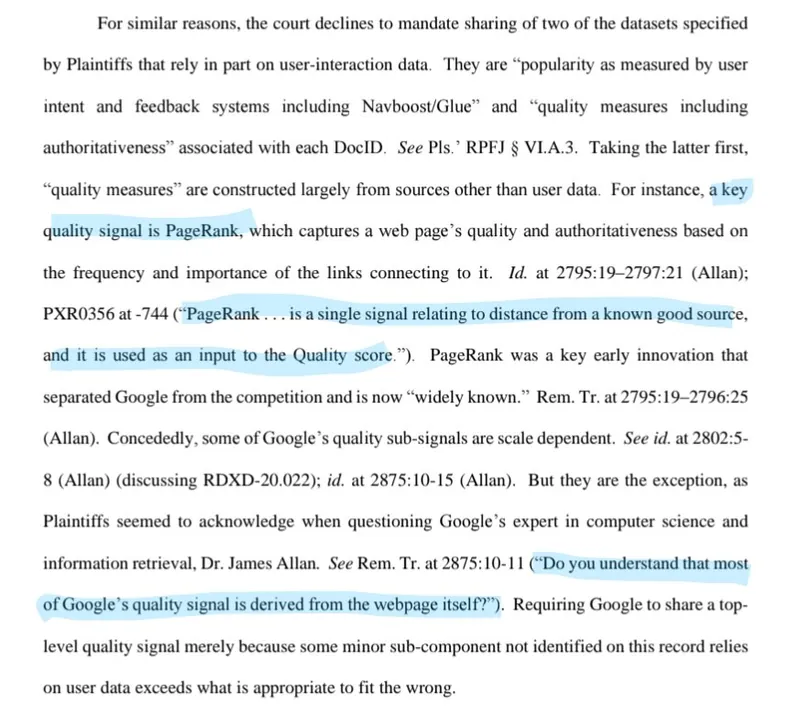
The practical implication: if your page has thin content, a wrong search intent match, or a broken UX, links won't save it. They'll temporarily boost it into positions it can't hold. Fix the page first.
The trial also confirmed something people speculate about: user interaction data does not influence PageRank. NavBoost is a separate ranking system, don't conflate it with PageRank.
"User interaction data does not play a role in PageRank."
"To generate the anchor signal, that's just from links between web pages, and it doesn't involve clicks."

Three Ways to Increase PageRank
There are three distinct mechanisms, though the first one gets almost all the attention.
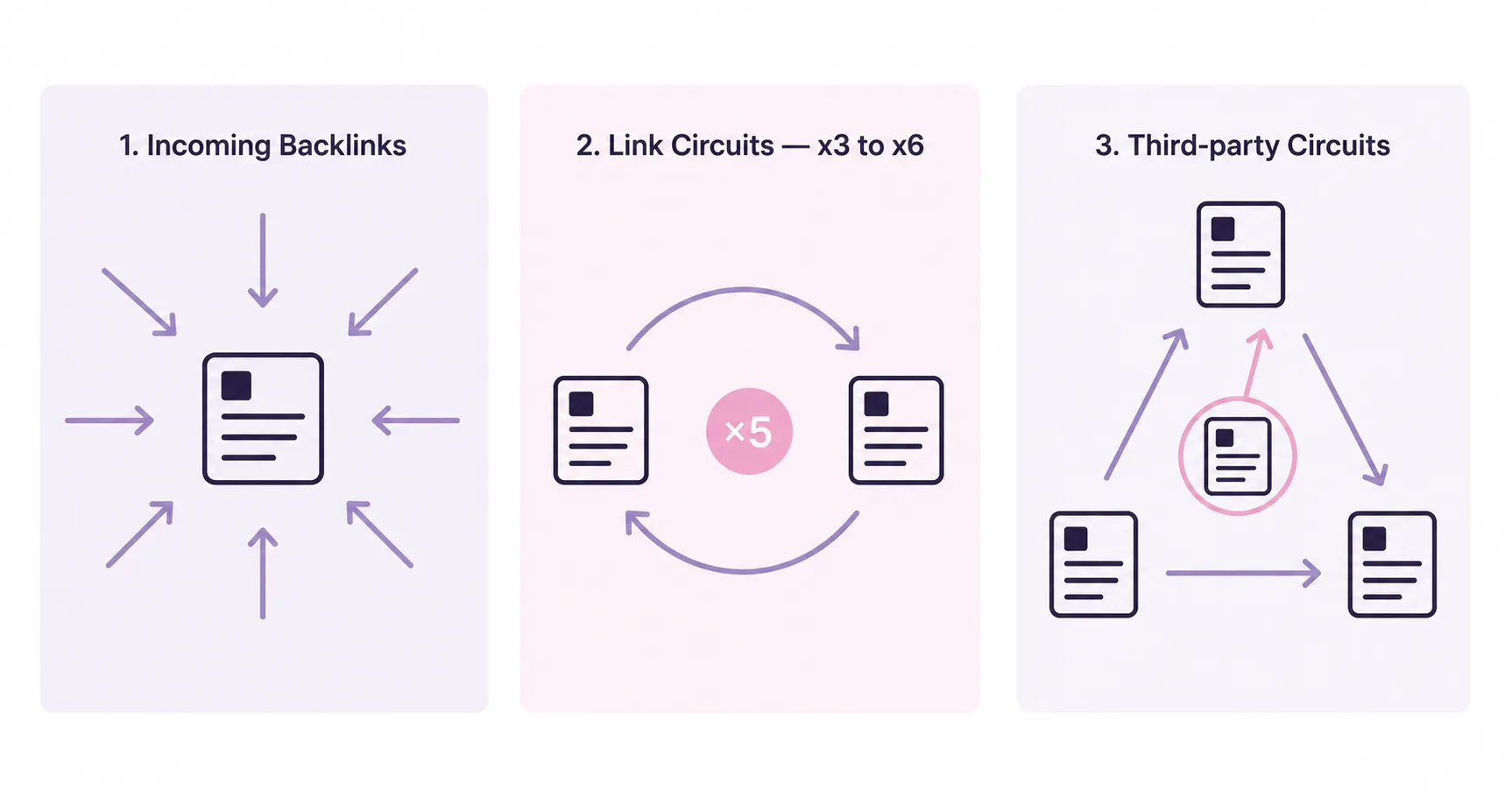
Links Transfer PageRank and Semantics
A link doesn't just pass popularity, it also transfers semantic context. The anchor text and the surrounding text (typically 10-15 words on each side) define how that link is "interpreted" by Google. The target page partially inherits the lexical field of the source context.
This is why anchor text choice isn't just about anti-Penguin hygiene, it's an active ranking signal for the target page. A link with well-chosen anchor text in a topically relevant paragraph transmits more thematic value than the same link in a generic article with no contextual match.
Position in the HTML also matters: links placed higher in the document code transmit more PageRank than footer or sidebar links. Not dramatically, but measurably.
There's one documented exception: a footer link on a single page is near-worthless. But a footer link on a large thematic site with thousands of relevant pages can accumulate significant cumulative PR transmission, the math works out differently at scale.
Links, PageRank, and Gemini Training Data
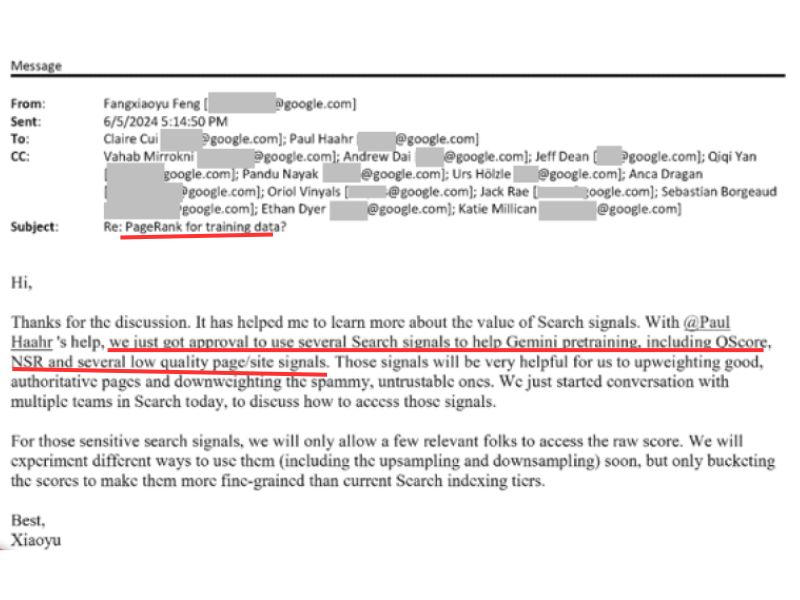
Here's something from the antitrust trial worth reading carefully. An internal Google email, submitted as evidence and disclosed on April 21, 2025, reveals that PageRank (and NSR, Nearest Seed Rank) are used to filter web data for Gemini pre-training.
Here is the passage that matters, in the author's own words:
"we just got approval to use several Search signals to help Gemini pretraining, including QScore, NSR and several low quality page/site signals. Those signals will be very helpful for us to upweighting good, authoritative pages and downweighting the spammy, untrustable ones."
What this means concretely: a page with strong backlinks is more likely to be considered "authoritative" and included in Gemini's training data. Your links now influence not just traditional rankings, but also whether your content appears in Google AI Overviews and Gemini responses.
Google's Index Is Tiered by Quality
The Leaks exposed an attribute called sourceType in the Alexandria indexing system. Google records the quality of the source page behind every anchor, and classifies links accordingly. There are three tiers:
One line from the Leaks matters here: "a lower source_type value indicates a more important anchor." So TYPE_HIGH_QUALITY is numerically the lowest value and the most valuable link, TYPE_LOW_QUALITY the highest value and the least. High quality equals the strongest link.
The practical consequence: Google officially confirms what everyone suspected. The index runs from top-quality sites down to a bottom tier, and anchors are ranked by the tier of the page carrying them. A link from a Tier 3 page is worth close to nothing. This is no longer SEO folklore, it is documented in Google's internal code.
How Google Processes a Link at Discovery
When a new link is discovered, the LinkExtractor breaks it into attributes: anchor text, surrounding context, source page, target page. Those attributes then pass through the AnchorAccumulator, which filters out redundant links, low-quality links, and links tied to irrelevant pages.
Several signals feed the decision on how much a link is worth: the pagerankWeight of the source, the total clicks on the source page, and the distance from the seed list. The Leaks also point to link classification tiers based on click data. Google can effectively ignore a backlink if its source page gets no clicks at all. A link on a dead page with zero visitors may simply not count.
Source Language and Country Are Tracked
The Leaks confirm two attributes recorded on every source page: language (integer, default English) and localCountryCodes (the countries the source page is local or most relevant to). These aren't assumptions, they are fields in the internal indexing system.
For a French site, prioritize spots on .fr domains or sites clearly localized to France. A DR80 American link on an English-language site transmits less geographic relevance than a well-themed DR40 French one. Same language, same country beats a foreign link with similar metrics, every time.
The Four Pillars of a Good Link
Strip everything down and a genuinely good link satisfies four conditions at once. It is the mental checklist I run on every spot:
9 Things to Do Before You Pull Out Your Credit Card
Before getting into platform selection, there's a checklist of free or near-free wins that regularly outperform purchased links, and they should be exhausted first.
1. Check What Google Already Prefers
Before buying a single link toward a page, check which page Google already "chooses" for your target query. Look at the live SERP and your own ranking history. Google may already favour a different URL on your site than the one you're about to push.
Don't force a page with links before running this check. If you pour links into a page Google isn't inclined to rank, you're fighting the algorithm instead of working with it.
2. Fix Your On-Site First
Links won't fix a broken foundation. Before any campaign: check the internal mesh pointing to your target page, resolve URL duplicates, and make sure the page actually satisfies search intent. Internal linking alone can sometimes outperform an external link.
E-commerce specific: the cart page naturally receives links from most product pages, which makes it one of the highest-PR pages on the whole site. Adding editorial content there (best-sellers, cross-sell blocks with thematic anchors) lets you redistribute that PR toward strategic pages. Massively underused.
Watch out for "parasite" pages too. If your footer or global menu links to "Shipping terms" or "Returns FAQ" on every single page, those pages hoard disproportionate internal PR. They can end up outranking product pages on generic terms, or just soaking up juice that should go elsewhere. Audit the pages receiving the most internal links, not only external backlinks.
3. Your Personal Network
Asking contacts for links is free, direct, and consistently underestimated. A former colleague, a supplier, a client who runs a relevant blog, one email can land a DR60 link that no platform can match at any price.
4. Reverse-Engineering Your Competitors
Identify the links that the top 10 results for your target query have in common. Use Ahrefs, Majestic, or Semrush. Filter to dofollow only. Look at the anchor distribution of your strongest competitors, that's your baseline ratio target.
Count the number of referring domains your top competitors have. If the winner has 45 RDs and you have 12, you know the approximate gap. Many of those links are obtainable for free or at low cost.
A real netlinking audit isn't just about checking whether you have enough referring domains. Two other questions matter just as much. First: do I have as many genuinely powerful links as my competitors? Not the raw RD count, but the number of links coming from strong pages. A rival with 20 RDs that includes five high-PR editorial links beats one with 50 weak ones. Second: is my optimized-anchor ratio in line with theirs? If the top results sit around 4% exact-match anchors and you're at 12%, you carry a Penguin exposure they don't, whatever your domain count says.
Don't benchmark against Amazon, YouTube, or large brands. Their link profiles are incomparable. That said: if you believe links are what you're missing to beat them on a specific query, don't be deterred, it's been done.
An experience I had with an e-commerce client: during competitive analysis, I noticed that several competitors were getting links from the brands of products they sell. This client sold over a hundred brands. We launched email outreach campaigns to those brands. Dozens of backlinks came back, stronger than anything available on any platform, and free. Competitive analysis reveals "natural" link opportunities you'd never think of otherwise.
5. Local SEO: Citations Before Links
If you're doing local SEO, NAP citations (Name / Address / Phone) on directories are a prerequisite to any paid link campaign. Pages Jaunes, Mappy, Facebook business profile, local associations, chamber of commerce directories.
That means one canonical version, used everywhere without variation. A phone number formatted differently between annuaires, a business name abbreviated in one directory and spelled out in another, an address that changed format when it was re-submitted years later: each inconsistency weakens the citation signal. Consistent NAP is how the aggregation works.
One extra tip: when you publish a sponsored article anywhere, ask for NAP in the author byline or a closing paragraph. It's an extra citation at zero marginal cost.
6. Forums and Ninja Linking
Active thematic forums are consistently underrated. Well-targeted, natural-looking profile, measurable SEO effects when done correctly. The key: contribute genuinely before placing any link. A real post history with value first, then a relevant link months later. Forum webprofiles on reference communities in your niche can transfer real thematic value.
7. Unlinked Mentions
Search for mentions of your brand that don't include a link. Put your brand name in quotes in Google, filtered to exclude your own domain. Then contact the author: the content exists, they already mentioned you, conversion rate is high. Free and systematically ignored.
Generate your Google unlinked mentions operator:
Google operator: unlinked mentions
Paste in Google to find all pages mentioning your brand that don't link to you.
8. Dead Link Building
Find broken links (404 errors) in reference articles in your niche. Contact the webmaster: "your link on X is broken, I have a resource that covers the same topic." Gagnant-gagnant for the editor. Solid conversion rates.
9. Case Studies with Your Paid Vendors
A free backlink almost nobody thinks to ask for: if you pay providers or tools, an agency, a SaaS, a freelancer, reach out and offer to be their case study. Vendors love a concrete client story to put on their site, and that story links back to you naturally.
You're already a paying customer, so the conversion rate is high and the link sits on a site with a real reason to exist. Go through everyone you send money to each month, each one is a potential link at zero extra cost.
Evaluating a Link Spot: My Criteria
When you’ve exhausted the free options, and you’ve genuinely confirmed you still need to acquire new backlinks at all, it’s time to buy. Here's how I evaluate a spot, and why I weight things the way I do.
The Link Buying Tier List
Buying a link is always a subtle job. There is no single silver-bullet metric, dozens of criteria come into play at once and they interact with each other.
That is exactly why I don't hand you one or two rules. A tier list is the right format here: it ranks each check by how much it actually matters, separating the false good ideas from the signals that are underrated but genuinely worth verifying.
I recently went through most of the catalogues on the existing link platforms to judge the quality of what they actually sell, SEO criteria weighed against price. The best platform in that study had only 11% of links worth buying. Every other one scored lower. That is the whole reason a demanding checklist matters: most of what is on sale simply isn't worth your money.
The rule that ties it all together: the more you pay for a link, the more demanding you should be. On a cheap spot you can let a few boxes go unticked. On an expensive one, aim to tick as many positive criteria as possible. Hover over any criterion below for what it means and how I weigh it.
Now let's go through each criterion that matters.
Price: The First Filter
Budget ceiling = scrutiny ceiling. The level of scrutiny you apply to a spot should scale with what you spend on it. Here's how I actually break down the price ranges:
€0 to €25: Very new sites or barely-disguised link farms, sometimes abandoned old domains. Don't expect real juice. The main value is anchor profile dilution. Take the risk without overthinking it.
€25 to €50: Same ballpark, better apparent metrics. A few genuinely interesting sites start appearing if you dig. Stay alert: metrics can be manipulated at this price level too.
€50 to €90: You start finding real gems if you look. A few Google News sites at this range, editors with stricter acceptance criteria. Also the range with the most manipulated metrics: sellers know buyers are starting to check, so appearances get polished.
€90 to €200: You can legitimately demand a certain standing. Real editorial line, no link farm signals, real and consistent authority over time. This is the range where the full checklist applies without compromise.
€200 to €500: Difficult to justify purely on PageRank. Worth it only if the site checks every single box, the business stakes on the target page are high, or you have an ambitious SEO budget to take a leadership position. Typical case: post-fundraising startup going for dominance.
€500+: At this price, you're no longer in pure backlink logic. You're in press relations: visibility, page traffic, branding signal. Buying a link at €800 solely for the PageRank it passes is rarely ROI-positive. But if that page generates real, qualified traffic to your site and reinforces your brand, the equation changes.
Thematic Match: Check the Actual Keywords
The check platforms skip: don't look at the site's general category label. Look at what it actually ranks for. Open the site in Ahrefs or Semrush, look at the keyword list. Are those keywords aligned with your target page's topic? That's thematic match, and it's the most important signal after price.
The theoretical basis: Haveliwala's 2003 paper on topic-sensitive PageRank showed that each page carries a popularity vector with one component per topic. When a user searches, Google uses only the component matching the query's topic. Off-topic links transmit generic PR, less valuable for your specific target keyword than a topically aligned link even with lower raw authority.
Practical filter: if the site's top-ranking keywords have zero overlap with your target page's topic, no metric will compensate for that. Thematic alignment is non-negotiable at the S tier.
One nuance, so this doesn't get read as dogma. Thematic links push harder, that part holds. But it shouldn't stop you from buying generalist spots when you spot a genuinely good opportunity, or when you simply need more links and you've already exhausted every catalogue in your niche. A strong generalist page carrying a topically-relevant article beats waiting months for a thematic spot that never shows up. Prioritize thematic, don't wall yourself off from the rest.
Organic Traffic: A Sanity Check, Not a Signal
Organic traffic scores from Ahrefs and Semrush are useful as a sanity check. They are not a direct PageRank signal. They're also manipulable on link marketplaces. Never use organic traffic as your primary criterion.
When a spot seems to have strong traffic, look deeper. Is that traffic coming from one URL that happened to rank on a lucky keyword? Or does the site have consistent organic coverage across many pages? The right question: what proportion of the site's total published pages actually rank in Google?
A site with 3 ranking pages out of 500 published is a weak signal, regardless of the traffic those 3 pages generate. Google's internal quality systems track exactly this kind of ratio. A site that publishes at scale but ranks on almost nothing is producing content Google doesn't trust, and links from that site reflect that.
Also check: is the traffic stable or in a declining trend since 2023? Many VDL sites took major hits. A site progressively recovering is a better buy than one in free-fall, regardless of current traffic numbers.
Homepage Proximity: Two Questions to Ask
The closer an article is to the homepage in terms of click depth, the more PR it receives from the site's internal link graph. An article accessible in one click from the homepage will consistently receive more authority than one buried three pagination layers deep.
Two practical questions before buying any spot:
First: if a new article is published on this site, will it be easily reachable by Google? Will it be picked up quickly in the link graph? Check whether the site's homepage lists recent articles, whether the category page is linked from the nav.
Second: in six months, once this article is "old," will it still be crawlable? If it disappears into page 10 of a category with no other internal links pointing to it, its value in the link graph drops significantly over time. Ask whether the editor has a process for keeping older articles linked.
PR Dilution Rate: Spotting Link Farms
A normal site redistributes between 3% and 10% of its internal PageRank outward through external links. Below 3%: the site hoards PR and doesn't let juice flow out. This isn't natural in the web graph. Above 10%: too many outgoing links, resembles a link farm identifiable as such by Google.
In practice: if a site has a disproportionate number of outgoing links relative to its size and content volume, that's a signal it's a disguised link farm. You can approximate this by looking at the ratio of linking domains vs. linked domains in any backlink tool.
Indexation: A Signal, Not a Gatekeeper
A lot of SEOs obsess over whether the article they bought is indexed, monitoring it and then trying to force re-indexation. Let me clear this up, because there are two separate things at play.
Indexation of the article you buy is a useful signal, nothing more. If the page is indexed, you know Google has crawled it, so it sits in the link graph and counts toward the PageRank calculation. Reassuring.
But the reverse is not true. A page that isn't indexed, or that gets de-indexed later, is not automatically dropped from the PageRank calculation. There can be a correlation between the two (page quality, spam signals and the usual SEO factors can push both the same way), but claiming "an unindexed page sends no juice" is simply false.
The clearest example: giant, hyper-authoritative sites, big press outlets, that have genuine indexation difficulties precisely because they are so massive. Some of their pages sit outside the index, yet those sites still transmit enormous authority. Index presence and link-graph presence are not the same thing.
Concretely: if an article you bought gets de-indexed, forcing re-indexation is pointless. Google didn't show enough interest to keep it in the index, and pushing it back in won't generate more PageRank or a fresh boost to your target page. There is nothing to gain there.
Where indexation does matter: if, like me, you want the host article itself to rank on specific keywords and generate visibility beyond the link, then yes, keep an eye on it. Otherwise, don't make a fixation of it. Assuming an unindexed page passes no PageRank is one of the most common and costly misconceptions in link buying.
The PAGE Is What Matters, Not the Site
One of the most common errors I see: evaluating a spot at the domain level, not the page level. A link on a page in your exact topic from a site that covers fifty topics is worth more than a link on a loosely-related page from an "authority" domain in your niche.
What actually matters: the specific page hosting your link, its keyword alignment with your target, and whether it avoids directly competing with your target page (you don't want the host article to rank for the same terms, creating cannibalization).
Practical consequence: a small site perfectly aligned on your topic can be worth more than a major generalist site. The intuitive ranking of "Le Monde > everything else" is often wrong in practice for a specific link.
Don't filter by site category on link platforms. The category assigned to a site reflects its dominant topic, not the topic of each individual page. A "tech" site can have a page that covers your exact subject perfectly. Filtering by category = missing perfectly-aligned spots at page level.
Anchor Text: Grammar, Variety, and Calibration
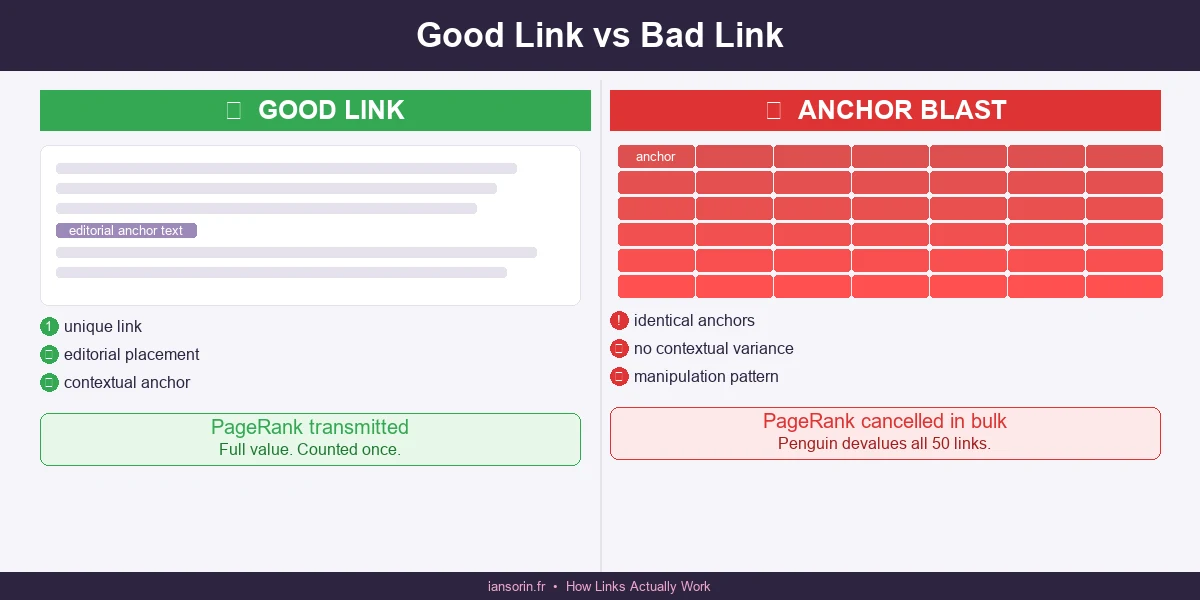
Anchors should be grammatically correct. "Agence de communication à Lyon" not "agence communication lyon." The SEO result is equivalent but the host text reads naturally, which matters for both editorial acceptance and Google's spam signals.
Never repeat the exact same long anchor across multiple spots. Variety is documented in the Leaks: the redundantAnchorsDropped mechanism caps the number of identical anchors Google counts from a given domain at around 200. Beyond that, the additional anchors don't count. Diversify.
The most important calibration rule: reserve exact-match anchors for your strongest spots. Put brand, generic, or URL anchors on everything else. An exact-match anchor on a weak spot doesn't help you rank. It just raises your optimized anchor ratio, which can trigger Penguin without delivering any benefit in return.
The Leaks also confirm anchorMismatchDemotion: Google detects and penalizes anchors that aren't contextually aligned with the source page's content. An anchor that "feels planted" in an unrelated article is a negative signal, not just a neutral one.
One more calibration rule, this time on volume. Keep exact-match anchors to roughly 3 to 5% of your overall profile (I aim for around 4.5%). And an exact anchor only counts as a ranking signal if it comes from a sufficiently strong page, roughly the top 30% of sites by thematic PageRank. Below that threshold, an exact anchor on a weak spot doesn't help you rank, it just inflates your optimized-anchor ratio with no upside, and potentially some Penguin downside.
What the Leaks put a number on. There is one line in the Leaks that actually quantifies this. In the IndexingDocjoinerAnchorStatistics entry, the field topPrOnsiteAnchorCount carries a telling note: an anchor coming from a page with PageRank above 51000 is the strongest kind, while anchors from pages below 47000 are all bucketed together as equivalent. The Leaks also reveal that PageRank here is stored as an integer between 0 and 65535.
All anchors treated the same. No differentiation.
Anchors start to carry real, differentiated weight.
What that lets us reasonably infer: if the source page's PageRank sits between 51000 and 65535, its anchor carries real, differentiated weight. If it sits under 47000, the anchor is worth no more than any other anchor at that baseline, it dissolves into the mass. Measured against the 65535 ceiling, the split is brutal. Only the top ~22% of URLs (above 51000) get fully weighted anchors, with a thin transition band stretching to roughly the top 29% (above 47000). The anchors of the bottom ~71% of the web are effectively flattened into one undifferentiated bucket.
In plain terms: a link from a weak page barely lifts your anchor above the noise, however perfectly optimized it is. This is the hard, numeric version of the rule above. Spend your best anchors on your strongest spots, because below a certain source-page strength the anchor signal simply flattens out.
My Exact Process
The "Double Effect" Approach
Buying links purely to accumulate backlinks is only half the job. Before any campaign, I run a keyword study to identify strategic queries that the client's main site can't (or shouldn't) target directly.
Types of queries typically covered via netlinking spots:
- "best [product category]" listicles
- "[client brand] vs [competitor]" comparisons
- "[client brand] review", third-party legitimacy required
- Informational queries where an external editorial voice is more credible than the brand itself
Result: double effect. The link boosts the target page. And the article on the spot site ranks for queries that serve your marketing funnel, at zero additional media cost once published.
The campaigns I see fail are the ones where someone just buys 20 links to the homepage with no strategy behind the content. Pure "fill the budget" approach. No directional value.
Don't Neglect the Homepage
Even if your home page targets no specific keyword, a share of your link budget should go there. Homepage links don't have a clean ROI short-term. But they're essential for overall domain health, and they're your best lever for anchor profile dilution.
If your homepage doesn't target a specific keyword: link to it with brand anchors, bare URLs, and generic anchors ("our website", "visit here"). That mass of neutral anchors mathematically buries your optimized anchor ratio, and looks perfectly natural.
Spending Leftover Budget
If you still have money in the netlinking envelope but nothing worthwhile left to buy in your niche, look at UGC link buys: forum posts, community platforms, and similar spots. Individually, this kind of link rarely moves rankings.
But a bit of natural-looking texture in your profile does no harm, and it doubles as anchor dilution if you're currently over-optimized. Don't force the last euros into a bad thematic spot just to spend them. A handful of cheap UGC links is often the smarter home for that residual budget.
The Double Loop Trick
When you buy from a spot: request one link to your homepage AND one link to a strategically chosen internal page that itself points to your real target page. Double effect: homepage boosted, internal page boosted, target page receives indirect PR amplification through your own internal structure.
Seasonal Planning and Transition Rank
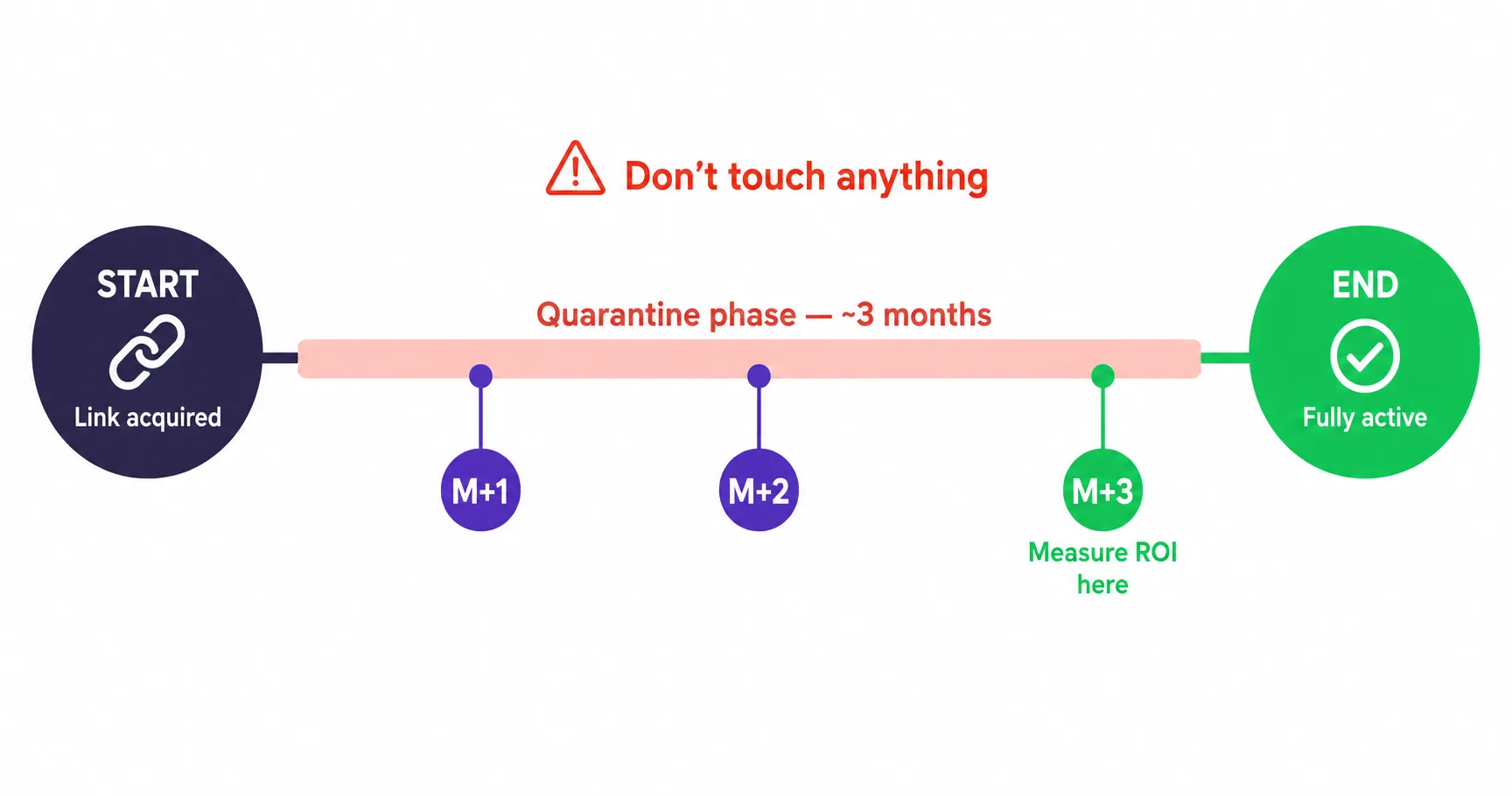
Google appears to maintain a ~3-month "transition" period after any significant modification to a page's link profile. During this period, rankings can fluctuate artificially lower. Attempting to re-optimize during the transition triggers a new transition, cascading instability.
This has two consequences:
First, after buying links to a page, don't touch the content or link structure for 3 months. Let Google integrate the signals calmly.
Second, for seasonal businesses: buy your links 3-4 months before your demand peak. An e-commerce site selling garden furniture should launch its netlinking campaign in December-January to be at full strength by March-April. Waiting until spring to buy links = paying for nothing this season. Agencies consistently get this timing wrong by starting when the client starts worrying, which is already too late.
First Links Matter Most, Confirmed in the Leaks
The Leaks reveal a boolean flag: penguinEarlyAnchorProtected, documented as "Doc is protected by goodness of early anchors." Google records whether a page received quality links early in its life. That record provides long-term protection against future Penguin algorithm updates.
Concrete implication: investing in quality links at the launch of a page or domain is not just "safer", it's building algorithmic protection that will compound over years. Starting with cheap links to fill volume, then trying to upgrade later, doesn't give you that early-anchor protection flag.

penguinEarlyAnchorProtected, good early anchors provide documented long-term Penguin protection.Acquisition Rhythm
Don't buy 50 links in a week. patent US20120209838A1 ↗ documents a growth rate formula: H = L / log(F+2), where L = links acquired and F = time factor. Spikes are filtered or mathematically capped.
Your acquisition velocity should track the competition, but above all it has to stay coherent with your brand's own popularity. At launch I wouldn't obsess over this, a young site gets some slack. Over the long run though, pulling in 30 links a month while your brand is searched only 100 times a month is exactly the kind of mismatch that reads as unnatural. Link growth that badly outpaces brand demand is a pattern, not a secret.
The picture changes once a site already has netlinking history and sits at the level of its market. You're no longer racing to catch up, so the job shifts to monitoring: watch the market to jump on the good backlink opportunities when they appear, and keep an eye on how fast the sector leaders are acquiring links so your own pace stays credible against theirs.
That same patent documents a few freshness mechanisms worth knowing. Links can be weighted by a function that increases with freshness: a link on a recently updated article weighs more than one on content frozen for years. There is also recursive freshness, where a page counts as fresh if a share of the links pointing to it are themselves fresh. A spot on a site with an active link profile transmits more value than one on an abandoned site.
Two more signals from the same source. Stable anchor text over time reads as natural, "good anchor text goes unchanged when a document is updated if still relevant." And a sudden mass loss of backlinks is a documented negative signal. Losing your good links is a real SEO problem, not a neutral event.
For competitive local SEO: 5-10 follow links can be enough to reach the top 10.
The conservative method: 5 links, wait 2-3 months, evaluate, repeat. Slow, but with no risk. If recent links haven't moved your target page, don't add more, diagnose first.
Combining backlinks + external traffic + social signals is always more convincing to Google than backlinks alone. Sometimes targeted traffic matters more than backlinks for establishing trust signals.
The Article Brief
Give the editor a brief: topic angle, link placement as high as possible in the body, a H2/H3 with your target keywords above the link. Find an angle that (a) fits the host site's thematic area, (b) covers a topic the site hasn't addressed yet, and (c) targets topics where that site already ranks well.
My preference: brief the editor rather than writing the article yourself. The site has already been flagged as sufficiently editorial quality, trust them to write it. If you write it yourself and it gets rejected, you've wasted time for nothing.
One non-negotiable: never commission an article that links exclusively to your site. Dan Petrovic has publicly demonstrated that he can algorithmically identify which site paid for a sponsored article in minutes. Google can do the same. Ask for 2-3 external links to non-competing reference sources (dictionaries, studies, official bodies in the niche). Yes, those outgoing links dilute PR slightly, but the naturalness they add is worth it many times over.

Buying on an Already-Ranked Article
A link embedded in a page already ranked in Google has a structural advantage: the page is stable in the primary or secondary index, with far less risk of de-indexation than a fresh article that starts strong (homepage PR) but slides down the site structure over time.
When I can get a link on a ranked page, I apply specific conditions:
- Add 150 to 250 words of fresh content. Not less (Google won't register the update), not significantly more (risk of disrupting the page's existing rankings).
- Place the link inside that new content block, not elsewhere on the page.
- Add a H2 or H3 with your target keywords above the new block. That's what gives the link its thematic context for Google.
- Don't ask the editor to update the publication date. The article's position in the site structure is valuable. Don't disturb it.
Why the fresh content is mandatory: the Google Leaks reveal an internal signal called QualityTimebasedLastSignificantUpdate: Google records the date of the last significant content update on a page (not a technical modification date, an actual content change). Adding only a link without surrounding content won't trigger this signal. The 150-250 words make the update detectable as real.
How to choose the right ranked page:
- Pages ranked in top 50 (positions beyond 50 are volatile and don't validate much)
- Look for pages ranking on cause/effect keywords related to your topic, not just your exact keyword (e.g. if targeting "SEO consultant," a page ranked on "website creation" is perfectly relevant)
- Avoid any page published less than 3 months ago: positions don't yet reflect long-term potential
- Don't overlook very old articles (2-3-10 years maintaining their rankings): long-term stability is a strong signal of Google's trust
- Check the site's overall health: proportion of ranking pages vs. total published pages
- Avoid pages already sold to multiple advertisers. Your competitors end up on the same page, and the link loses power
Pushing URLs That Already Link to You
Often overlooked: acquiring links toward pages that already link to your target page. You receive indirect authority from that chain even from thematically distant sites (the intermediate page handles the thematic alignment). You also revive historical backlinks that may have lost value as the source page aged out of internal prominence.
For large media sites: your sponsored article loses internal PR over time as it slides deeper into pagination. Buy external links pointing to that article page to maintain its authority in the host site's internal link graph, and sustain the value it transmits to you.
One cheap habit I build into every campaign: a small recurring top-up on my most expensive backlinks. Every six months or so, I send a little relinking their way, €5 to €10 is plenty, purely to keep them active.
It ties back to the recursive freshness signal above: a link counts for more when the page carrying it still receives fresh links of its own. A costly press or authority link left untouched for two years slowly bleeds part of the value you paid for. A modest periodic refresh protects that investment for a fraction of the original spend.
Measure and Decide
For every link you buy, check positions on the target page 3 months later. Estimate traffic gained, conversion delta, and annualized revenue impact. If link buying is a net drain on your business budget with no measurable return: don't persist. The goal is ROI, not link count.
Mistakes I See All the Time
In no particular order, the patterns I see recur with depressing regularity.
Buying without seeing the spot first. I've tested several platforms that sell in bulk without showing you what you're buying. The links delivered were dead sites with no PR, with artificially inflated metrics. You only discover this after payment. Non-negotiable rule: always see the spot before buying.
PBN links. Google detects PBN patterns algorithmically with trivial ease: identical templates, shared IP blocks, matching nameservers, similar content structure, abnormal incoming/outgoing link ratios. A "clean" PBN is extremely expensive to maintain. One update and an entire network gets neutralized in bulk.
How to spot a PBN before buying: look at the site's own backlinks in Ahrefs or Majestic. Do the linking domains look like real sites with real audiences? Or like generic recycled domains ("best-tips-online.net", "quality-articles-hub.com")? Visit those sites. A real editorial site receives links from real sources. A VDL site in a network mostly receives links from other network sites, visible in 5 minutes.
That said, nothing in this game is black and white, and this is where I'll add some nuance. In my own testing, PBNs are genuinely hard to get real results from, that part holds. But at the very bottom of the price scale, under €30, I'll still take a shot at a few spots that stand slightly above the pack, even when they're visibly PBN-adjacent. In every price bracket I try to spot the underpriced gem and drop it into the batch, PBN or not. The one rule I never break: I keep my most optimized anchors off those links. Worst case, they quietly do anchor profile dilution work, which is the one thing that bottom tier is actually good for.
Exact-match anchor blasts. A volume of identical anchors on a short acquisition curve is cancelled in bulk by AnchorSpamPenalizer. You've consumed your optimized anchor quota with zero net benefit.
Buying links before fixing on-site. Canonical issues, URL duplicates, wrong intent match, these problems don't go away with links. They get amplified.
Sites with obvious low-quality AI content. No editorial angle, no information value, no real stance on anything. Content that exists purely to exist, churned out at scale with no thought given to the reader. Impossible to read, impossible to trust. Google's quality systems are specifically built to handle this at scale, and those sites lose indexation fast.
Paying for a nofollow link. Zero direct SEO value. Some SEOs advise buying nofollow links to "balance" a link profile, but sites accumulate nofollow links naturally through social media, press, forums and Wikipedia. There is no need to pay for them. The nofollow/dofollow ratio is not a documented ranking signal.
Sitewide rented links. If you stop paying and the link disappears, the negative impact of losing it is greater than never having had it. The net effect of a sitewide link rental is negative if you ever need to stop.
Losing your best links. The real negative SEO risk isn't receiving bad links, it's losing good ones. Monitor your backlink profile. A sudden mass loss of strong backlinks is a serious SEO problem, documented in internal Google systems.
Obsessing over NF/DF ratios. Nofollow links appear naturally at scale (social media, press, Wikipedia, forums). There is no magic "balance" to achieve. Never pay for a nofollow link to hit some ratio. This is a myth that costs people real money.
Not measuring after 3 months. The most common mistake: spending €2000/month on links without ever checking what happened. Track positions on target pages, compare before/after, estimate ROI. If you can't demonstrate value, stop.
Common WordPress templates with AI or stock imagery. The more widespread a template, the less the site was invested in, and generally the lower its quality. Same story for AI-generated visuals or generic stock photos. It is one signal among hundreds, not an absolute rule, but VDL sites carrying these patterns tend to lose their indexation fast.
Penalized sites. A brutal traffic drop on the analytics tools is a clear avoid. You don't want your link sitting on a site Google has already demoted.
Sites with mass automated publishing. Your article gets buried in pagination within days. The exception is a genuine media outlet with human editors that simply has high legitimate volume, that is a different situation and can be worth it.
Before You Start Buying Links
The biggest mistake in link buying is not buying the wrong link. It is letting someone convince you that buying links is always the right move, that it is the solution you absolutely have to use, that it will fix everything. It will not. I have personally seen projects, my own and others, where relentless link buying produced no measurable return and burned through budget that could have gone somewhere smarter.
You can build genuinely strong SEO without buying a single link. If your site needs more links, there are ways to earn them that do not involve payment: outreach, partnerships, content that earns links naturally. Link buying is one tool in the toolkit. Not the only one, and not always the right one.
When it is the right tool, I have described the conditions above: the right site, the right criteria, the right moment in the campaign, and a clear ROI model before you commit. Outside of those conditions, it is expensive, slow, and often disappointing.
One specific red flag: be very suspicious of any consultant or agency that recommends buying links without having actually looked at your site. Without analyzing your technical setup, your existing profile, your competitive landscape. Many people in this industry have a direct financial interest in keeping you buying links. The whole sector profits from it.
I am one of them. I sell links. And precisely because I sell links, I want to be honest with you: buying links is not always necessary, not always the right call, and not always the right moment. There are rare conditions where it makes financial sense. Outside of those conditions, the money is better spent elsewhere. I would rather tell you this now than watch you spend budget on something that will not move your numbers.