

The Ultimate Consulting Guide for My Fellow SEOs

The Ultimate Consulting Guide for My Fellow SEOs
The SEO industry has a consulting problem. Here's the fix.
 Ian Sorin
May 3, 2026
25 min read
Ian Sorin
May 3, 2026
25 min read
25 min read
Updated July 27, 2026
Here’s a controversial take: the SEO industry has a consulting problem (and maybe a knowledge problem too, but that’s another story).
Thousands of SEO pros obsess over algorithm updates, crawl budgets, and schema markup. They debate title tags on Twitter and dissect Google patents. Yet when they sit in front of a client, they fumble. They ramble. They under-deliver. Not because they don’t know SEO, but because nobody ever taught them how to be a consultant.
Being an SEO consultant is about 80-90% consulting and 10-20% SEO. The SEO part? You can learn it. It’s documented, testable, Googleable. The consulting part? That’s where careers are made or broken.
Here’s the thing: yes, knowing SEO is great. But clients don’t just pay for knowledge. They pay to feel accompanied, supported, relieved. They want a consultant who takes weight off their shoulders, not one who adds complexity to their plate. Being that kind of consultant, the one who makes your client’s life easier, is a real craft. And it’s what makes all the difference.
My honest opinion: I’d rather hire a great consultant who’s mediocre at SEO than a great SEO who’s a terrible consultant. The first one will learn the craft and retain clients. The second one will lose accounts no matter how brilliant their audits are.
This guide is everything I wish someone had told me on day one.
TL;DR
- Mindset first: every interaction is a “conviction transfer.” Your job is to raise your client’s confidence above a decision threshold.
- Trust has a formula: (Credibility + Reliability + Intimacy) / Self-Orientation. The fastest way to earn it is to shrink self-orientation by giving value for free, expecting nothing back.
- Structure beats vocabulary: always lead with the conclusion (Minto Pyramid), then support with evidence.
- Listen before you speak: active listening is the most underrated consulting skill.
- Meetings are won before they start: prepare your objective, anticipate questions, structure your agenda.
- Difficult conversations need curiosity, not combativeness: acknowledge first, then inform, then propose.
- Written communication: if you can’t say it in 3 sentences, rethink it. Kill hesitant language.
- Be proactive, not reactive: push information, don’t wait to be asked.
- Handle criticism with power moves: silence, “maybe so,” and deferring.
- Be a chameleon: match your client’s mood. Play along when they joke. Show frustration when they’re frustrated. Emotional synchrony smooths the entire relationship.
1. The Mindset: Your Operating System
Before tactics and frameworks, let’s talk about the mental foundation. If your internal operating system is broken, none of it will land.
Every Interaction Is a Conviction Transfer
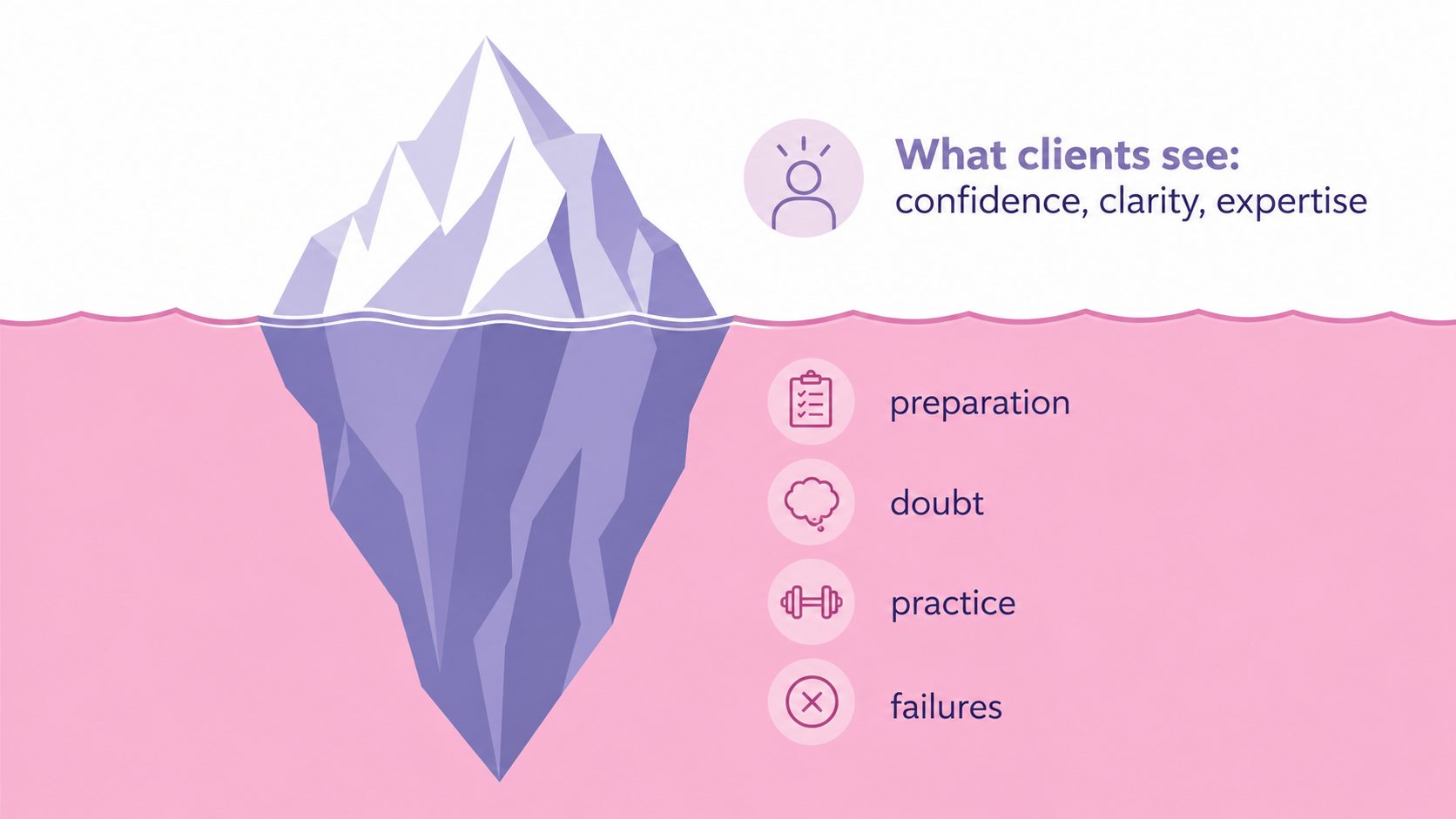
Every client interaction (meeting, email, Slack message) is a conviction transfer. You walk in with a high level of belief. Your job? Transfer enough conviction so their confidence crosses the decision threshold.
Everything you do has a net effect: it raises, lowers, or maintains their conviction. Think of it as a score.
• Strong, structured intro? +5
• Fumbled answer to a question? -3
• Personal connection point? +4
• Getting caught bluffing? -5
• Data-backed recommendation? +6
• Rambling without structure? -4
At the end of the meeting, the total score determines whether they trust you, follow your recommendations, or quietly start looking for another agency.
Two ways to maximize this:
- Raise your own conviction first. Study, prepare, accumulate experience. If you don’t believe in what you’re recommending, they’ll feel it.
- Optimize the transfer through content (concrete examples, proof) AND form (structure, conciseness, confident tone).
The Trust Equation: The One Variable That Cancels Everything
That conviction score is my own shorthand. But there is a more rigorous model behind it, and it is worth knowing by name: the Trust Equation, from David Maister’s book The Trusted Advisor (2000, co-written with Charles Green and Robert Galford). Maister spent his career studying professional service firms, and this is the cleanest model I have found for why a client actually decides to trust you.
It looks like this:
Read it as a real fraction. The three things on top build trust. The one thing underneath quietly destroys it. Here is what each term means, and how you move it:
| Variable | What it really asks | How to move it in your favor |
|---|---|---|
| Credibility the words |
Do you actually know your stuff? Built on expertise, track record, and saying true, accurate things. | Back claims with data, show past results, and openly say what you don’t know instead of bluffing. |
| Reliability the actions |
Do you do what you said you would? It is the gap between what you promise and what you deliver. | Hit every deadline, even the five-minute ones. Under-promise, over-deliver, repeat. |
| Intimacy the safety |
Does the client feel safe being fully honest with you? This is the emotional side of trust. | Listen properly, remember the personal details, and never break a confidence. |
| Self-Orientation the divisor |
Who are you really focused on, them or yourself? This is the only term sitting under the line. | Lower it: give value for free, put their result before your invoice, and drop the ego. |
The three variables on top add up, so a gap in one can be covered by another. You can be slightly less experienced (lower credibility) and still be deeply trusted if the client feels you truly have their back (high intimacy) and you never miss a deadline (high reliability).
But self-orientation sits underneath the line, and that is what changes everything. It is a divisor. The more a client senses that you are thinking about your own invoice, your next upsell, or your ego before their result, the more it divides down (and eventually cancels) everything you stacked on top.
This is why a technically brilliant consultant can still feel like “just a vendor.” It is rarely a credibility problem. It is almost always a self-orientation problem: the client can feel that you are waiting for the engagement to close before you really engage.
The strongest antidote I know is almost embarrassingly simple: do something genuinely useful for the client, for free, expecting nothing in return.
Send the quick competitor teardown you spotted on a Sunday. Flag the broken redirect before anyone asks. Share the tool that saves their team an afternoon, even when it sits completely outside your scope.
Each of those says the same thing, louder than any pitch: I am thinking about your result, not my billing. That is self-orientation dropping toward zero, and when the denominator shrinks, trust climbs fast.
The 4 Pillars of Professional Value
Your value as a consultant rests on 4 pillars:
- Domain Expertise: your technical SEO knowledge. Comes with time.
- Execution Rigor: thoroughness, attention to detail, follow-through. Available from day one.
- Attitude / Energy: enthusiasm, solution-oriented mindset. Available from day one.
- Relationships: internal network, trust built over time. Grows progressively.
Authenticity: The Foundation of Respect
Real professional presence comes from internal security: knowing what you bring, without needing to prove it.
Authenticity: not trying to prove anything, having your own style, being comfortable with disagreement.
Insecurity: name-dropping, trying to befriend everyone immediately, showing off status.
Keep Your Promises (Starting with Yourself)
The foundation of respect is doing what you say you’ll do. Starting with promises to yourself.
Nobody will call you out when you promise “I’ll send it by 5pm” and deliver at 5:15pm the next day. But everyone notices. Over time, these small slips destroy credibility.
The golden rule: set realistic commitments rather than over-promising. It’s better to say “Wednesday” and deliver Tuesday, than to promise Monday and deliver Wednesday.
Impostor Syndrome: Understand It to Beat It
About 90% of high achievers are “insecure overachievers.” If proving your worth is your main driver, no success will silence the doubt. Each win brings temporary relief, then the void returns.
The root: believing you should know everything, while assuming everyone else does. In reality, even the most senior people wing it daily on imperfect information.
• “I don’t know” is a professional answer. Nobody knows everything.
• If you’re in the room, you deserve to be there. You didn’t get here by accident.
• Stop putting others on a pedestal. “Experts” are winging it too; they just hide it better.
• Separate your worth from your performance. A bad month doesn’t make you a bad consultant.
• Act despite doubt. Doubt shrinks with accumulated experience.
• Keep a “wins journal.” Re-read it when the syndrome hits.
2. Talk Like You Know (Even When You Don’t)
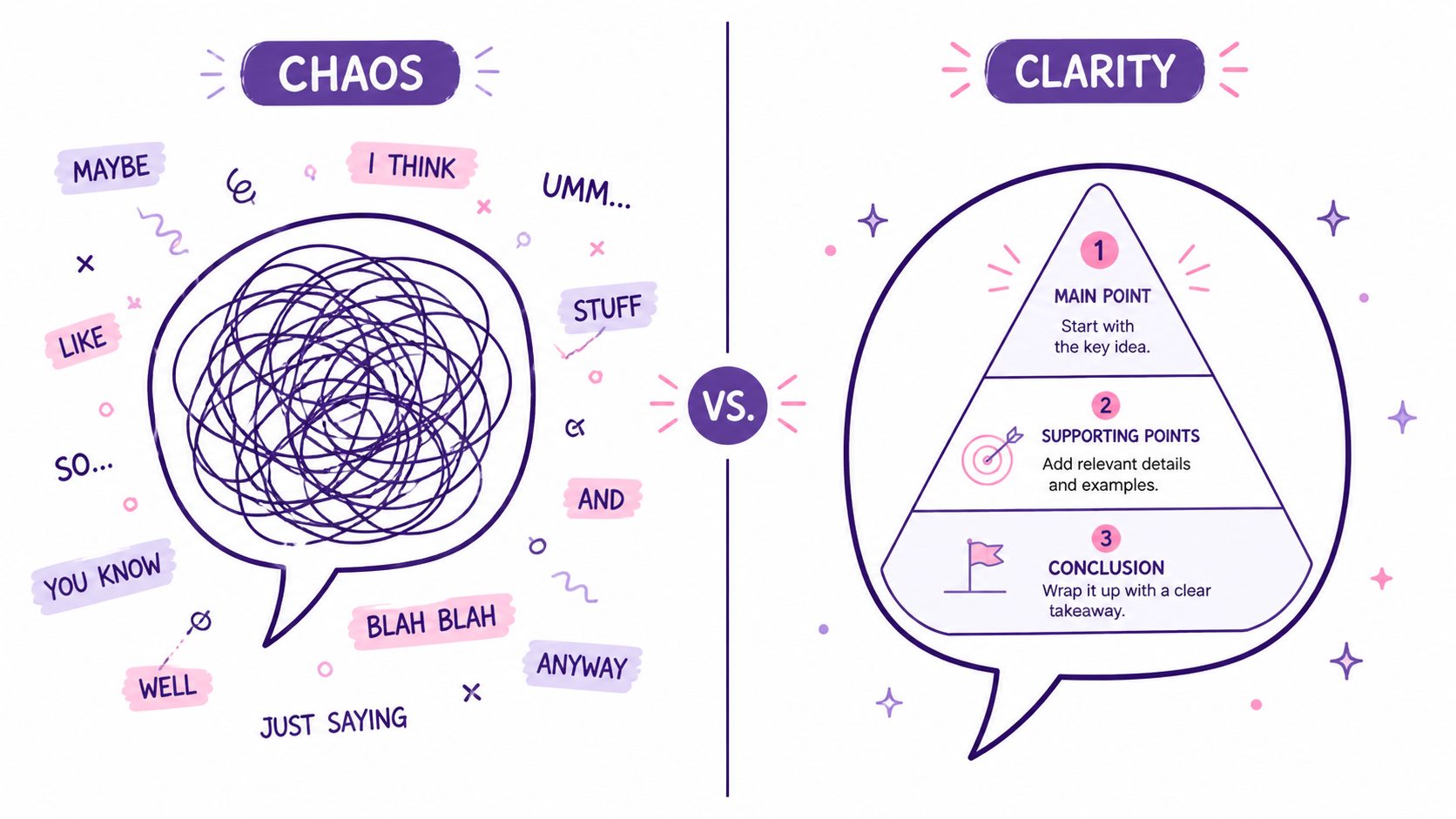
How you structure your message matters more than what words you choose. Disorganized ideas force your listener to do the reconstruction work. Most won’t bother.
Understand Before You Explain
If you can’t explain it simply, you don’t understand it well enough. Feynman Technique: explain it like you’re talking to a 5-year-old. Where you stumble is where you need to dig deeper.
For complex problems, use First Principles Thinking: break everything to its most basic components. The “5 Whys” method is your friend.
Define Your Objective Before You Open Your Mouth
Before every conversation, know exactly what you want to achieve. Without a clear objective, every word is wasted. Examples: “I want them to validate the Q3 action plan.” “I want Search Console access.” “I want them to prioritize between two options.”
Write this objective at the top of your meeting notes. Every time.
Structure Your Message: Top-Down (Minto Pyramid)
This is the communication standard at McKinsey, BCG, and Bain, and it works just as well in SEO consulting:
- Start with your main idea / conclusion
- Announce your structure: “There are 3 points to cover”
- Develop each point with evidence and examples
- Close with a clear call to action
Adapt Your Message to Your Audience
The Curse of Knowledge: the more expert you are, the more you overestimate what others know. Jargon and acronyms create walls.
Default assumption: your audience has less context than you. It’s easier to ramp up in complexity than to recover a lost listener.
1. Why should they care?
2. What do they already know?
3. What do I know that they don’t?
4. How can I bridge the gap most efficiently?
With a VP or director, start at the strategic level (business impact, budget, goals), then drill down. They think in terms of “So what?”
Pro tip: use analogies. They bridge unknown concepts to things your audience already understands. Most powerful communication tool there is.
Anticipate Questions & Reduce Cognitive Load
A good communicator predicts questions and answers them preemptively. Every word must earn its place. If you can remove it without losing meaning, remove it.
Voice & Presence
Downspeak: end sentences with a descending tone, never rising. Rising = uncertainty. When nervous, you speed up and your voice goes higher. Slow down, and it drops naturally.
The Anchor Effect: people listen to the person who speaks less but whose every word counts. Slow down, lower your tone, become the anchor.
Quality over quantity: imagine a high-jump bar. Jump below it regularly? You earn a noise reputation. Clear it every time? People learn to pay attention when you speak.
Words That Push vs. Words That Brake
Filler words to eliminate: “like,” “actually,” “sort of,” “maybe,” “uh”
Start with: “I recommend,” “The priority is,” “Because,” “Here’s what matters”
3. The Art of Listening: The Most Underrated Skill
Here’s an uncomfortable truth: most of us don’t actually listen. We wait for our turn to talk. And people can tell.
Listening to Understand vs. Listening to Respond
Listening to respond: while the other person is talking, you’re already preparing your answer. You’re not really listening. They sense it and close off.
Listening to understand: you suspend judgment. You genuinely try to see their perspective. You observe tone, body language, emotions.
The 5 Steps of Active Listening in Disagreement
- Catch yourself: when you feel the urge to argue, STOP.
- Look beyond words: listen to tone, body language, emotions.
- Validate and acknowledge: “Thank you for sharing that. I see where you’re coming from.”
- Ask open questions: “Can you tell me more about that?”
- ONLY THEN share your point of view.
Ego Is the Enemy of Communication
When you “win” an argument by humiliating someone, you get a dopamine hit. But the long-term cost is enormous: that person will never want to help you again.
If a colleague says something wrong in a meeting, don’t correct them publicly. Validate, then complement: “That’s a good point, and on top of that, there’s also [subtle correction].”
4. Own the Room: Meetings
Meetings are where reputations are built or destroyed. Like any performance, the magic is in the preparation.
The 3-Step Preparation Framework
Step 1: Clarify Your Objective
- What do I want to achieve in this specific meeting?
- Why do I care about this?
- Why should THEY care? (the critical one)
Step 2: Map Dependencies
Reverse-plan: to reach my objective, what do I need to communicate, to whom, with what evidence? And what do I need to prepare for that?
Step 3: Execute
- Announce the agenda upfront
- Conclusion first (top-down)
- Spell out implications and actions: “What this means for you is…”
- Close with next steps: “[Person A] does [X], [Person B] does [Y], I’ll handle [Z], we reconvene on [date].”
When You’re Put on the Spot
It will happen. A client asks something you don’t know. A director challenges your recommendation. Here are the 3 fatal mistakes to avoid:
1. Uncontrolled rambling: talking endlessly to fill the silence.
2. Bluffing: total credibility loss if caught.
3. Self-flagellation: excessive apologies project zero confidence.
Instead, use this 4-step framework:
🎬 Scenario: “What’s the expected traffic impact of these changes?”
Step 1 – Mental reset phrase: “That’s a great question.” (buys you 2-3 seconds)
Step 2 – Reframe and clarify: “If I understand correctly, you’re asking about the projected organic traffic uplift from the technical fixes we’ve outlined?”
Step 3 – Say what you DO know: “I don’t have the exact projection yet, but what I can tell you is that similar fixes on comparable sites have yielded 15-30% traffic gains within 3-6 months.”
Step 4 – Propose a path: “I’ll build a projection model based on your specific data and share it by Thursday. Does that work for you?”
🎬 Scenario: “Why hasn’t the strategy delivered results yet?”
Step 1 – Mental reset: “I appreciate you bringing that up.”
Step 2 – Reframe: “To make sure we’re aligned: you’re wondering why we haven’t seen significant organic traffic movement since the strategy kicked off 8 weeks ago?”
Step 3 – What you know: “Based on industry benchmarks, SEO initiatives typically need 3-6 months to show measurable impact. What we’ve seen so far is that indexation has improved by 40% and our key pages are now being crawled daily, which are leading indicators.”
Step 4 – Path forward: “I’ll put together a leading-vs-lagging indicators dashboard so we can track progress more granularly. I’ll have it ready by next week’s meeting.”
The Hypothesis-Based Assertion
When you don’t know the answer, take a position on a hypothesis, own that you could be wrong, and propose a plan to verify. Three qualities of a good assertion: action-oriented (includes next steps), logical (coherent reasoning), and delivered with conviction.
The Power of Silence
Silence is one of the most powerful tools in your arsenal. When you pause: you give yourself time to think, you appear more thoughtful and composed, and your audience digests what you just said.
Most people are uncomfortable with silence and rush to fill it. Resisting that impulse is a massive competitive advantage.
Second-Order Thinking
Don’t think just one move ahead, think at least two. Instead of “I need this data,” think “I need this data, I can find it here, and if it’s not there, I’ll look there.” Anticipation is what separates consultants who appear effortless from those who seem constantly surprised.
5. Difficult Conversations & Client Pushback
Difficult conversations are inevitable. How you handle them defines your professional reputation.

Approach with Curiosity, Never Combativeness
The moment the other person senses combativeness, they shut down. Curiosity disarms. Tone matters more than words.
Fun fact: teams that regularly challenge each other make better decisions than those that avoid disagreement.
The ALINON Framework for Diplomatic Disagreement
- Acknowledge: “I completely understand. I can see this is an important priority for you.”
- Listen: “I’d like to understand a bit better how you see things.”
- Inform: “Based on our experience, we’ve found that X happens, so I think we should anticipate Y.”
- Options: “Here’s what I’d propose as an alternative…”
- Negotiate: “What would make you comfortable with this adjusted plan?”
Frame the Conversation Before It Starts
Use a 3-part conversational frame:
- Announce the topic: say precisely what you’ll discuss.
- Announce the desired outcome: say how you want the conversation to end.
- Get agreement: ask if they’re OK with this frame.
Template: “I’d like to discuss [topic]. Ideally, by the end, I’d like us to be aligned on [outcome]. Does that work for you?”
Don’t Try to “Win” Arguments
When you try to win an argument, you lose the relationship. See disagreements as something to UNTANGLE, not WIN.
The Water Glass Analogy
You can’t fill a glass that’s already full. Create space by letting them empty theirs first.
Questions that help them “empty” their glass:
- “How did you arrive at that conclusion?”
- “Where did you learn about that?”
- “How long have you been thinking about it this way?”
Key rule: minds don’t change in a single conversation. It takes hundreds.
The Magic Question: “What Am I Missing?”
This question disarms, shows humility, and often reveals information you didn’t expect.
Name Your Emotions to Control Them
When you name an emotion out loud, you control it instead of it controlling you.
Don’t Argue the Opinion, Identify the Need
When someone expresses a strong opinion, don’t debate it (tip of the iceberg). Identify the deeper need: security, control, fear of change, fear of loss.
Acknowledge the need without approving the opinion:
- “I hear that the security of your business is really important to you.”
- “It sounds like this really matters to you.”
- “That’s useful to know, thanks for sharing.”
Managing “Triggered” People
When someone reacts disproportionately:
- Add temporal distance: “We can park this for now. Let’s revisit it later.”
- Never force their timeline: “We NEED to talk about this NOW” is the worst thing to say.
- Revisit in a framed 2nd conversation: “I’d like to come back to what we discussed. I’m not trying to resolve anything, I just want to understand your perspective.”
Preparing for a Stressful Conversation
- Define your objective BEFORE emotions do. It should be something YOU control (not “I want them to apologize”).
- Regulate your body MORE than rehearsing your words. Rehearsing word-for-word sounds manufactured. Instead, identify your stress signals.
- Only rehearse your opening line. 98% of a conversation’s direction is set by the tone and first words.
• “I’d like to share something that’s really important to me.”
• “I know this won’t be perfect, and that’s okay.”
• “This conversation stresses me out because it matters a lot to me.”
6. Written Communication
You probably spend more time writing (emails, Slack, reports, audits) than talking. Every written word is a permanent record of your competence.
Switch to Voice When There’s Friction
Text doesn’t carry emotional nuance. If an email thread exceeds 3 back-and-forth without resolution, pick up the phone.
Give the Benefit of the Doubt
Never presume negative intent. Use “Did you mean…?” to clarify before reacting. 9 times out of 10: “No, not at all, I was just in a rush.”
The 3-Sentence Rule
If you can’t say it in 3 sentences, rethink it. Length is often a sign you haven’t thought enough about the message.
Kill Hesitant Language
❌ “I just wanted to…” → ✅ “I wanted to…”
❌ “I was wondering if…” → ✅ Ask the question directly
❌ “This might be a dumb question but…” → ✅ Ask the question directly
❌ “I don’t know if this is a good idea but…” → ✅ “I propose…”
❌ “Is that clear?” → ✅ “What are your questions?”
Turn Apologies Into Gratitude
Game-changer. “Thanks for your patience” makes the other person think “Yes, I am patient.” Even if they were annoyed, the word “patience” repositions them positively.
❌ “Sorry for the late reply” → ✅ “Thanks for your patience”
❌ “Sorry, just seeing this now” → ✅ “Thanks for giving me time to think about it”
❌ “Sorry to bother you” → ✅ “I’d like to discuss something with you”
❌ “Sorry it’s a bit long” → ✅ “Thanks for the time you’ll spend on this”
Compassionate Directness
Being direct doesn’t mean lacking empathy. It means having enough confidence to respect both the other person AND yourself.
The Art of Synthesis
Synthesis is a muscle. Write the message, then cut it in half. “If I could only keep one sentence, which one?”
7. Be Proactive, Not Reactive
This is the section that separates the consultants who keep accounts for years from those who churn after 6 months.
Push vs. Pull
Clients are used to “pulling” information from you. When you proactively “push” solutions and updates, it gets noticed immediately.
Extreme Ownership
Treat every project as if you were personally responsible for it, even the parts you didn’t produce yourself.
“Eat the Frog”: take ownership of the most painful task that your manager or client has been putting off. That’s the fastest way to create value, even without deep expertise.
Solution Mindset vs. Problem Mindset
Never say “I don’t know” and stop there. Always add: “but here’s how we can find out.”
Bring the Energy
When you’re junior, you don’t have expertise. But you can be the person who moves things forward: first to propose solutions, first to follow up on stalled topics, first to speak in awkward silences.
It’s exhausting. That’s why so few do it consistently. But it’s what gets you labeled “reliable” and “great attitude.”
Be a Chameleon: Match Your Client’s Energy
Enthusiasm alone isn’t enough. The best consultants don’t just bring energy; they read the room and adapt to the energy that’s already there.
Think of it as emotional mirroring. People feel closer to people who “get” their current state. When you sync with someone’s mood, you stop being “the consultant” and start being someone who actually understands their world.
They open the call laughing about their Monday morning. Play along. Laugh. Match that lightness. A consultant who can joke back builds a very different kind of relationship than one who stays stiff and professional 24/7.
Don’t stay cheerful and solution-oriented. That reads as tone-deaf. Match the frustration first: “Yeah, that situation is genuinely annoying.” Let them feel heard. Then, and only then, move to solutions.
The key distinction: you’re not faking emotions. You’re choosing which genuine reaction to surface. When a client is frustrated with a slow dev team or a platform bug, you probably ARE frustrated too. Show it.
Staying in “positive professional mode” regardless of what the client is feeling comes across as disconnected. Emotional synchrony is a trust signal: clients who feel genuinely understood are easier to work with on everything else. It smooths the entire relationship, not just the moment.
8. Handle Criticism Like a Pro
Criticism is coming. The question isn’t whether; it’s how you’ll respond.
Internal Psychological Protection
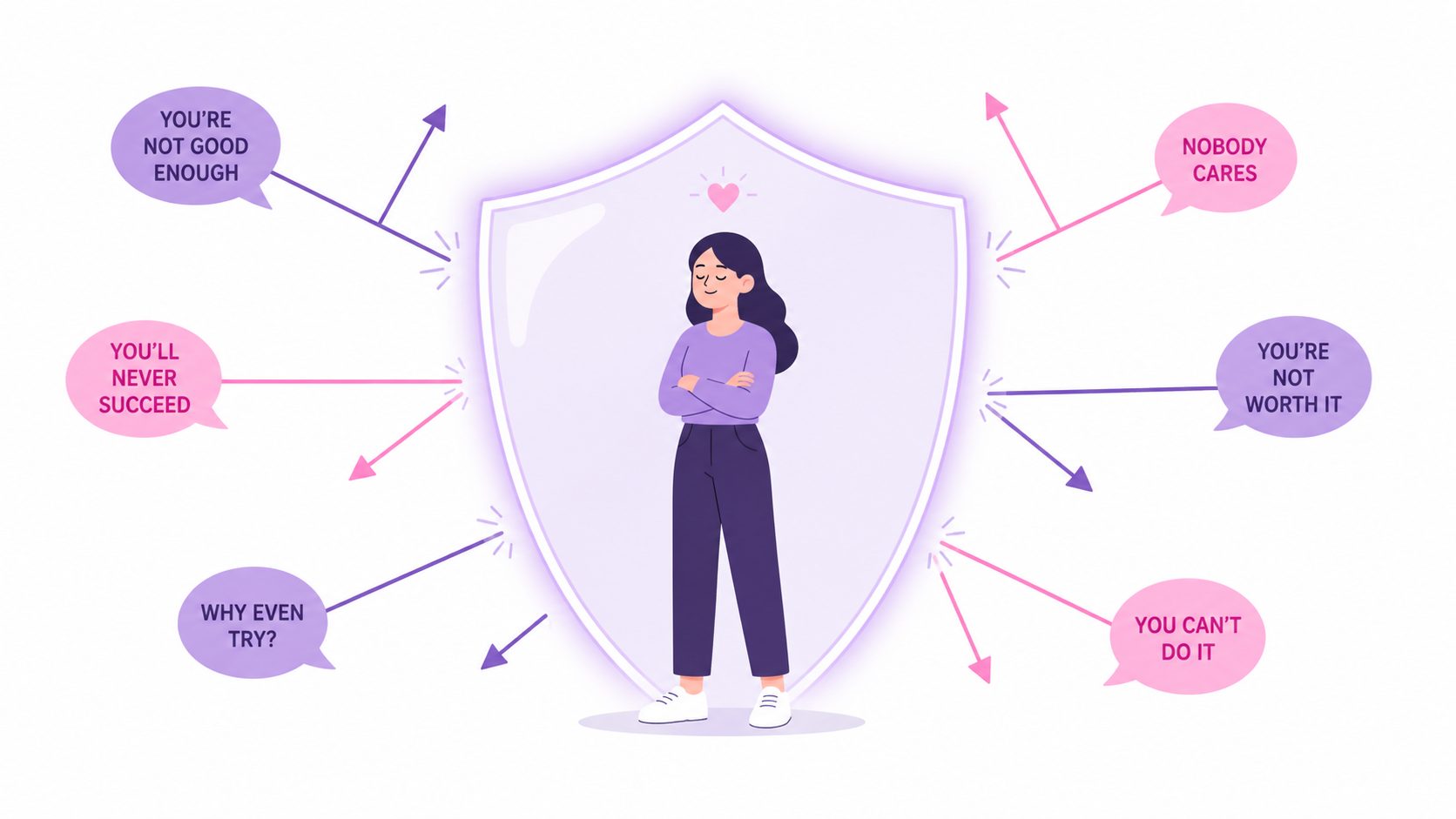
- The Energy Shield: visualize a force field around you. Words slide off like water off a duck’s back.
- The Ego Separation: “They’re not talking to ME, they’re talking to my ego.” Place the ego mentally beside you; detach from the emotional charge.
- The Mental Trash Can: visualize a trash can next to you. Sort: discard offensive remarks, keep only constructive elements. The problem they’re exposing isn’t the real problem. Sort to find the real message buried under the jabs.
The 3 Power Moves
Set Boundaries Without Apologizing
Respected people set boundaries without apologizing. Justify or apologize for a boundary, and you diminish it.
Remember: someone being uncomfortable with your boundary doesn’t mean the boundary is wrong.
Replace “But” with “And”
The word “but” erases everything said before it. The word “and” builds bridges.
When Tension Rises: Slow Down
When tension rises, don’t speed up. Fishing line metaphor: pull too hard, the line snaps. Slow down, articulate, pause. You keep control, and your counterpart regulates too (mirror effect).
The Negotiation Phrase: “What’s the possibility that…”
It doesn’t put the other person in a position to refuse directly. Frames the request as a possibility, not a demand. “What’s the possibility that we start with a strategy audit before committing long-term?”
9. Cheat Sheets
Everything above, distilled into copy-paste-ready phrases and checklists you can reference before every important interaction.
Phrases Ready to Use
• “Here’s what I know.”
• “Here’s my position on this.”
• “Here’s what I’ve observed.”
• “I don’t have a firm opinion yet, but here’s what I’ve identified so far.”
• “Here’s my conclusion.”
• “I totally understand. What if we looked at it from this angle…”
• “Help me find the knot.”
• “What am I missing?”
• “I agree this is a topic worth discussing.”
• “I hear that this is important to you.”
• “I don’t need to agree with you to understand you.”
• “I need to stop you there.”
• “I need us to refocus on [topic].”
• “This type of communication doesn’t work for me.”
• “If [behavior X continues], then [consequence].”
• “That’s a great question.”
• “If I understand correctly, you’re asking…”
• “I don’t have the exact number, but what I know is…”
• “I’ll dig into this and get back to you by [date].”
• “What’s the possibility that…”
• “Today, I’ll cover 3 points.”
• “What this means for you is…”
• “Concretely, the next step would be…”
• “To summarize next steps: [actions, owners, deadlines].”
• “I’d like to discuss something with you” (not “sorry to bother you”)
• “Thanks for your patience” (not “sorry for the delay”)
• “I propose…” (not “I don’t know if this is a good idea but…”)
• “What are your questions?” (not “Is that clear?”)
Pre-Meeting Checklist
Pre-Email Checklist
Key Takeaways
SEO consulting is 80% consulting, 20% SEO. Invest in the 80%.
A well-structured average idea beats a brilliant but chaotic one.
The best communicators speak less and listen more.
Approach every disagreement as something to untangle, not to win.
Proactive consultants keep accounts. Reactive ones churn.
The ability to not fill silence is a competitive advantage.
Being a great consultant isn’t about knowing everything. It’s about communicating what you know, handling what you don’t, and making people feel heard and confident in your guidance.
The SEO knowledge will come. These consulting fundamentals? They’re the foundation everything else is built on. And unlike an algorithm update, they won’t change overnight.
That’s all for today. Bye!
Ian Sorin is an SEO consultant based in Lyon, France. With a deep passion for understanding how search engines work under the hood, he specializes in technical SEO and data-driven strategies.