308 People Were Watched While Shopping Online. Here Is What Actually Changed Their Mind.
308 People Were Watched While Shopping Online. Here Is What Actually Changed Their Mind.
A behavioral study on what actually moves online shoppers.
 Ian Sorin
April 15, 2026
7 min read
Ian Sorin
April 15, 2026
7 min read
Hey, it's Ian!
You've probably heard this before: people say they care about ethics, sustainability, product origin. But when they actually buy something, price wins.
Researchers call this the "intention-behaviour gap." And it's been frustrating marketers, UX designers, and search engineers for years. A study published at ACM SIGIR CHIIR 2025 just gave us some of the clearest data yet on what actually bridges that gap.
- 308 participants were observed searching for ethical info about a product they were actively buying
- Searching changed their minds: importance of ethical factors increased significantly after the search task
- What did NOT drive change: how much they searched, how many pages they opened, their existing ethical values
- What DID drive change: recognizing they had a knowledge gap + finding information easy to understand
- Biggest effect on: consumers who initially cared least about ethics
- For product sites: clarity and surfacing the unknown matter more than volume of information
The Study: 308 Real Shoppers, One Task
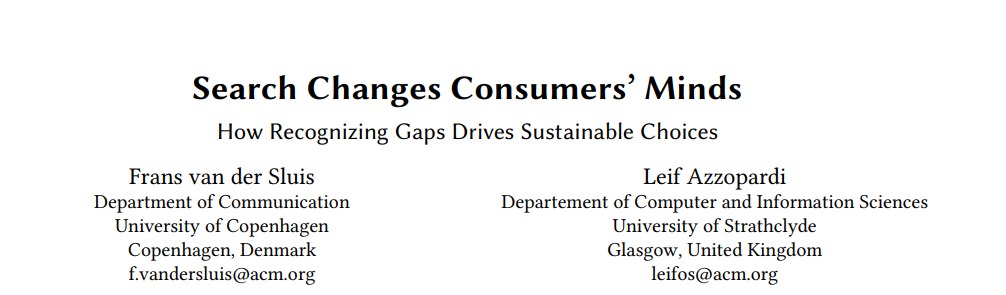
The researchers recruited 308 participants via Prolific. Each person was already in the process of buying something that cost at least $100 or €100 (consumer electronics, clothing, appliances, sports gear).
They were then asked to spend 10 minutes searching for information on one of eight ethical aspects of that product: labour conditions, eco-friendliness, product origin, sourcing, governance, social impact, DEI, or ideology. Researchers tracked their search sessions and measured how their priorities shifted before and after the task.
The result? A clean, measurable study on how real search behaviour changes real consumer minds.
Yes, Searching Actually Changes Minds
The first finding is encouraging. After the search task, participants rated ethical considerations significantly more important than they had before (mean increase: +0.31, t(322) = 5.28, p < .001).
This held across different product categories and across all eight ethical aspects. Searching for information about a product shifts what you value in that product.
But that's not the interesting part. The interesting part is why it worked, and what didn't explain it at all.
Three Things That Did Not Drive the Change
The researchers tested the obvious suspects. Does the effect come from people who already care about ethics? Does it come from searching more, opening more pages, spending more time?
The answer was no on all counts. Here's the data.
What had NO significant effect on importance change:
The ethical intentions finding is particularly striking. The researchers measured each participant's Ethically Minded Consumer Behavior (EMCB) score and split them into three clusters: Low (22.9%), Medium (34.9%), and High (31.4%).
High-EMCB participants already placed more importance on ethics before searching. But after the task, all three groups showed the same level of change: roughly equal shifts, regardless of starting values.
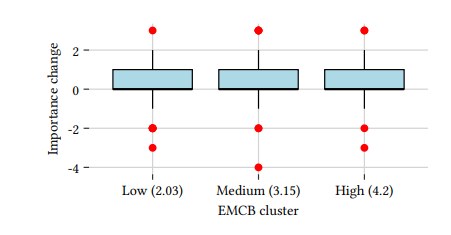
Three boxes, nearly identical ranges, all centered around zero with similar spreads. Having strong ethical convictions going in gives you no advantage in changing further during search.
What Actually Changed Their Minds
Two factors consistently predicted importance change, and neither is about quantity of effort.
The first is Decision-Making Recognition (β = 0.23, p < .001): the subjective feeling of realizing you had gaps in your knowledge or decision-making. Not just finding information. Specifically recognizing that there was something you did not know that mattered.
The second is Sense-Making Ease (β = 0.17, p < .001): finding the information easy to understand, evaluate, and trust. When participants felt they could make sense of what they found, importance shifted more.
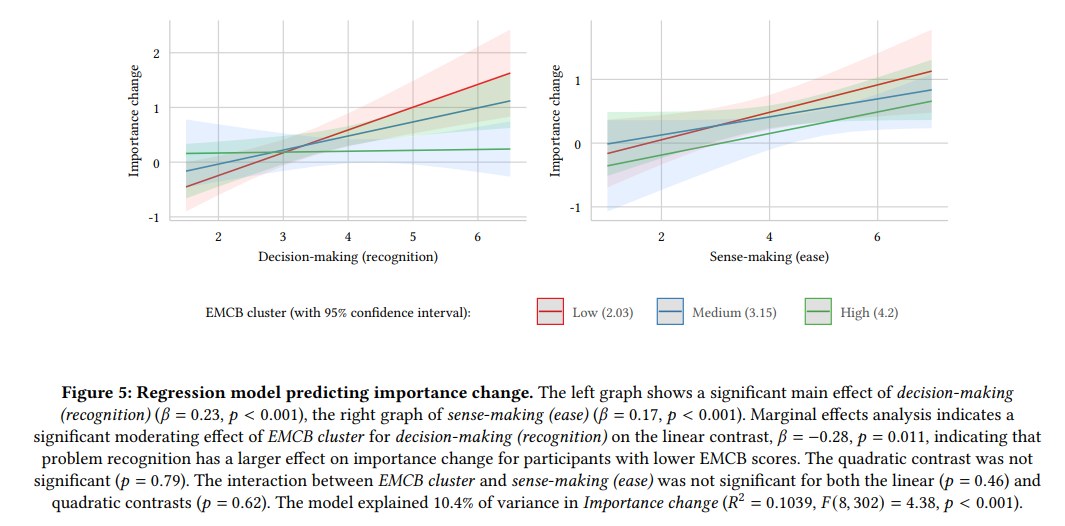
Notice the left graph: the effect of recognition is steepest for Low EMCB consumers (β moderation = -0.28, p = .011). The people who cared least going in showed the greatest shift when they recognized a gap.
The right graph tells a different story: sense-making ease works uniformly. Make information clear and understandable, and it moves the needle regardless of the user's initial values.
The 8 Ethical Aspects: Not All Equal
The study tested eight different ethical topics. Participants were randomly assigned to search on one of them, and the data shows meaningful differences in how much each topic shifted importance.
Average importance change after search, by ethical aspect
Mean change on importance scale (pre vs. post search task). Source: Table 1, van der Sluis & Azzopardi, 2025.
Sourcing (+0.53) led the pack, meaning learning about where materials come from had the largest effect on shifting priorities. Governance (-0.12) was the only aspect where importance actually dropped slightly after searching, possibly because participants found corporate governance harder to evaluate or less personally relevant.
One important note: the ANOVA showed no statistically significant difference between aspects for importance change (F(7,315) = 1.45, p = .186). The differences in the chart are directionally informative, but the effect of searching seems to apply broadly regardless of which ethical topic was assigned.
The "Recognition Moment": How It Works
The key mechanism in this study is what the researchers call Decision-Making Recognition: the moment a user realizes their current knowledge is incomplete in a way that matters for their decision.
It is not just "I found information." It is "I did not know this, and now I do, and it changes how I think about my choice." That specific cognitive event is what drives importance change.
User starts searching with existing beliefs
"I want a good product at a fair price. I vaguely care about ethics but it's not my main filter."
They encounter something they did not know
Clear, understandable information reveals a gap: "I had no idea this product was sourced this way."
Recognition happens
They realize this gap was relevant to their decision all along. Not just new info: a new frame for evaluating their choice.
Priorities shift
The ethical factor now weighs more in their decision. Not because they were convinced: because they understood something they had not seen before.
What the data confirms is that this sequence matters more than raw information volume. Participants who reported higher recognition scores showed more searching afterwards, more desire to change future habits, and more actual importance change.
What This Means When You Sell Products Online
The study is about ethical consumption, but the mechanism it identifies applies broadly. Any time a user is in purchase mode, the gap between what they know and what could matter to them is an opportunity.
Two levers stand out from the data.
First: surface what users do not know they are missing. The recognition effect was strongest for users who cared least at the start. Your product page is not just describing a product: it is an opportunity to create the "I did not know this" moment for users who had not considered a dimension of value you can offer.
Second: make information easy to process. Sense-making ease (β = 0.17) worked uniformly across all user types. The barrier is rarely the absence of information: it is complexity, jargon, and formats that are hard to evaluate quickly. A clearer page shifts priorities more reliably than a longer one.
Does your product page trigger recognition?
A quick self-audit based on the study's two key drivers.
One more thing worth noting from the paper: the study was incentivized (participants were paid via Prolific to engage with this task). The authors themselves flag that in real-world conditions, the recognition moment needs to be triggered by the page itself, not an external prompt.
That makes the design of your product page even more important. If the information is there but buried, unclear, or framed as marketing copy rather than genuine insight, the recognition moment never happens.
That's all for today. Bye!
Key Takeaways
Actively searching for product information measurably shifts what users value in a purchase decision (p < .001).
More queries, more pages, more time: none of these predicted importance change. How much you search is irrelevant.
The "I did not know this" moment is the key driver. The strongest effect appeared in users who initially cared least.
Sense-making ease consistently predicts change across all user types. Clear information moves priorities more than detailed information.
Ian Sorin is an SEO consultant at Empirik, a digital marketing agency based in Lyon, France. With a deep passion for understanding how search engines work under the hood, he specializes in technical SEO and helping websites get discovered, crawled, and indexed effectively.