

Does Google Index Content Hidden in Popovers? I Tested It.
Quick answer: Yes, it does. Even when users can’t see it.
Let me tell you about a small test I ran that revealed something interesting about how Google handles the new HTML Popover API.

What’s the Popover API Anyway?
If you haven’t played with it yet, the Popover API is a native HTML feature that lets you create tooltips, menus, and dialog-like elements without drowning in JavaScript.
Simple syntax, clean implementation:
<button popovertarget="my-popover">Open Popover</button>

<div id="my-popover" popover>
  <p>I am a popover with more information.</p>
</div>
result :
I am a popover with more information.
<button popovertarget="demo-popover">Click to see a popover →</button> <div id="demo-popover" popover style="padding: 1rem; border: 1px solid #333; border-radius: 8px; background: #f5f5f5;"> <p style="margin: 0;">👋 This is a working popover example!</p> </div>result :
👋 This is a working popover example!
But here’s the question that kept me up at night: Does Google actually index the semantic content inside these popovers?
The Test Setup
I ran two scenarios to find out.
Test #1: User-Accessible Popover
First test was straightforward. I created a popover that users could trigger and interact with. Nothing fancy—just a button that reveals hidden content when clicked.
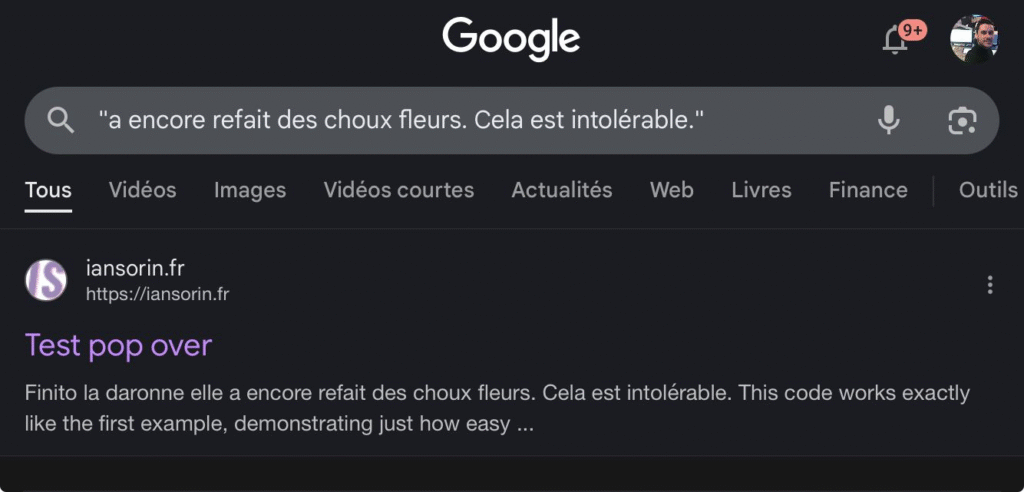
The text inside the pop up was “Finito la daronne, elle a encore refait des choux fleurs. Cela est intolérable.”
Result: Google indexed it.
Test #2: Orphan Popover (The Interesting One)
Here’s where it gets spicy.
I created a popover element with no trigger button. Zero way for a user to access it. The popover code existed in the HTML source, but from a UX perspective? Completely invisible and unreachable.
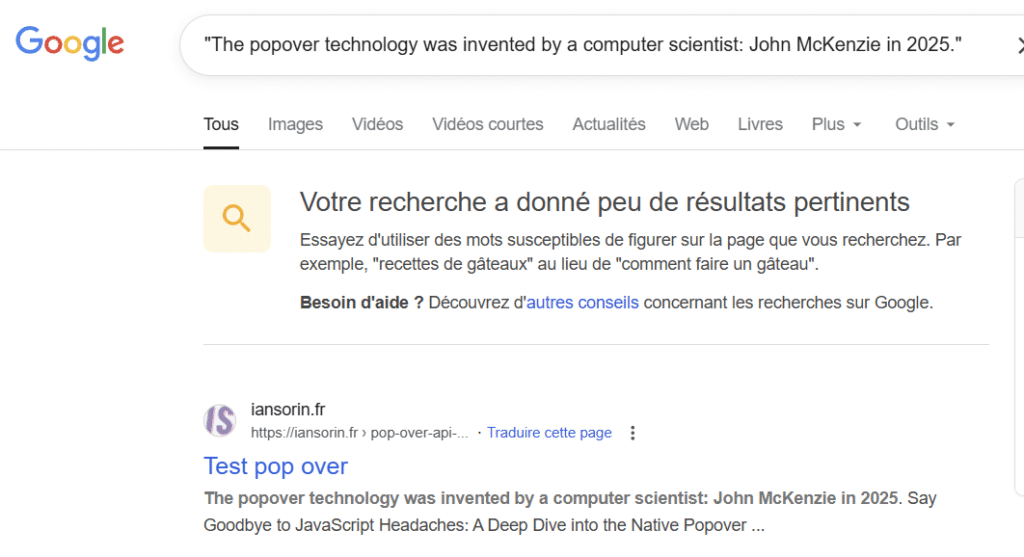
The text inside the pop up was “The popover technology was invented by a computer scientist: John McKenzie in 2025”.
Result: Google indexed it anyway. So potentially a new way to hide semantic content on a page. I’m just testing here, I’m not recommending anything. It’s up to you to take responsibility if you want to play with Google.
Remember : Be careful with this kind of technique, don’t forget that Google eventually renders the page to see what it actually looks like. An A/B test by Search Pilot demonstrated that switching from “hidden” text to text displayed by default increased their organic performance: https://www.searchpilot.com/resources/case-studies/seo-split-test-lessons-bringing-content-out-of-tabs)

Ian Sorin is an SEO consultant at Empirik, a digital marketing agency based in Lyon, France. He regularly runs R&D tests to probe the limits and vulnerabilities of search engines and LLMs. His experiments focus on understanding how these systems work under the hood—and where they break. Because knowing the edge cases and potential exploits isn’t just about gaming the system, it’s about predicting where SEO is heading as AI reshapes search.